

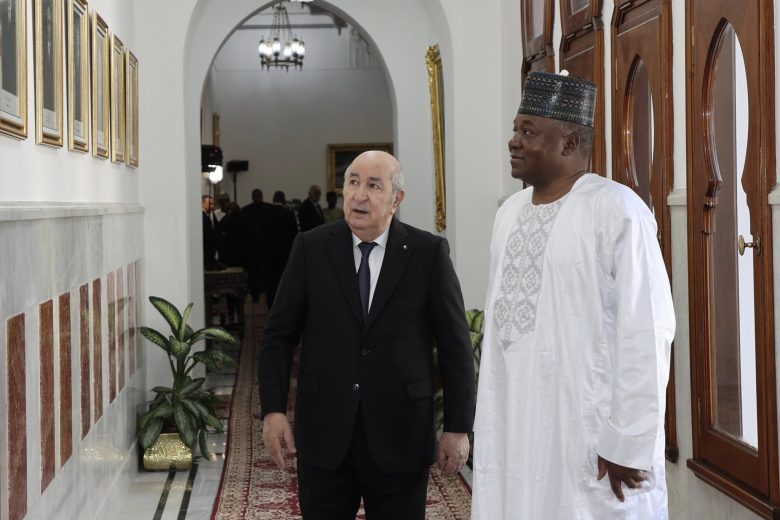
Supported by the Trans-Saharan Gas Pipeline project (TSGP), the renewed diplomatic rapport between Algiers and Niamey is making an impact on multiple fronts, starting with strengthened security control, economic development, and regional solidarity. This is what geopolitical and geo-economic expert Arslane Chikhaoui indicated, commenting on the visit of Nigerien President Abdourahamane Tiani to Algeria, which marks the beginning of a new era of cooperation between the two countries.
Analyst Arslane Chikhaoui stated that this “working and friendship” trip unquestionably reflects a firmly established political will to elevate bilateral cooperation to a higher level and consolidate trust between the two states. “This renewed trust already forms the foundation for the return of Algerian-Nigerien relations to normal,” he added during an appearance on National Radio.
Based on his observations, the two countries had no choice but to reach an agreement to prevent exploitation by certain non-African countries intent on “keeping the continent in a state of extreme underdevelopment.” “While some developed states have introduced development aid, Algeria has chosen solidarity within the framework of good neighborliness,” he continued. This approach would, in his view, stabilize—to a certain extent—the western zone of Niger (the epicenter of violence and insecurity in the Sahel), particularly the tri-border region (Niger, Mali, Burkina Faso).
In the same vein, the speaker emphasized that the two heads of state had reaffirmed their commitment to the fundamental principles of “non-alignment” governing bilateral relations, particularly regarding respect for national sovereignty, territorial integrity, and non-interference in internal affairs, as well as the imperative of showing solidarity against common threats. He explained that these concepts, “inherited from Algeria’s diplomatic history and non-alignment, remain structuring elements in the regional doctrine.”
Returning in detail to the regional situation, the speaker considered this rapprochement to have major symbolic and strategic importance for the entire Sahel. In this regard, he recalled that politico-military crises and low-intensity conflicts had weakened the Saharan-Sahelian space, subsequently fueling a climate of security uncertainty.
In this tense context, the resumption of Algerian-Nigerien cooperation will, from his perspective, “reduce risks of instability and contain cross-border threats, especially in the southwestern Nigerien zones subjected to strong security pressures.” Along the same lines, the expert did not fail to highlight the pressing need to integrate “economic development and security” to optimally combat terrorism, narcotrafficking, human and arms trafficking, in addition to irregular migrations. In this sense, he argued that the absence of stability hinders development, while underdevelopment fosters the spread of instability and increased migratory flows toward neighboring countries and Europe, while noting that intra-African immigration is far more significant (80%).
On the same front, Arslane Chikhaoui spotlighted Algeria’s pivotal role as a central stabilization actor in the Sahelian space. This positioning, he explained, is based on a “diplomacy of proximity,” centered on economic, energy, and mining dimensions, which bolsters the country’s comprehensive approach in the region. “This strategy aims to preserve a space of common interests against the influences of extra-regional actors and fits into a vision of lasting stability for the Saharan-Sahelian region,” he noted.
Furthermore, the speaker mentioned the revival of the Trans-Saharan Gas Pipeline project (TSGP), which he views as a structuring lever for economic and energy partnership between the two countries. Supported by the Sonatrach Group, this project plans to transport gas from Nigeria to Europe via Niger and Algeria. This pipeline spans more than 4,000 kilometers, making it one of the major energy projects linking Africa to the European market. “Through this project, Africa is taking charge of itself,” he affirmed. “This project goes beyond mere energy dimensions to become a tool for territorial stabilization, thanks to the creation of local jobs and economic development in border zones, historically seen as natural spaces for human and commercial exchanges,” he added. Mr. Chikhaoui specified that Niger could directly benefit from the project through financial royalties or ecosystem services, representing a sustainable investment for its economy.
This approach, he estimated, moves away from old exploitation logics in favor of a partnership presented as “balanced and mutually beneficial.” In any case, this project, he indicated, strengthens Algeria’s position as an indispensable energy actor and strategic bridge between Africa and Europe. The analyst believes that beyond the economic return on investment, this project illustrates a concrete vision of African cooperation, reflecting the continent’s ability to autonomously address its economic and geopolitical challenges.