

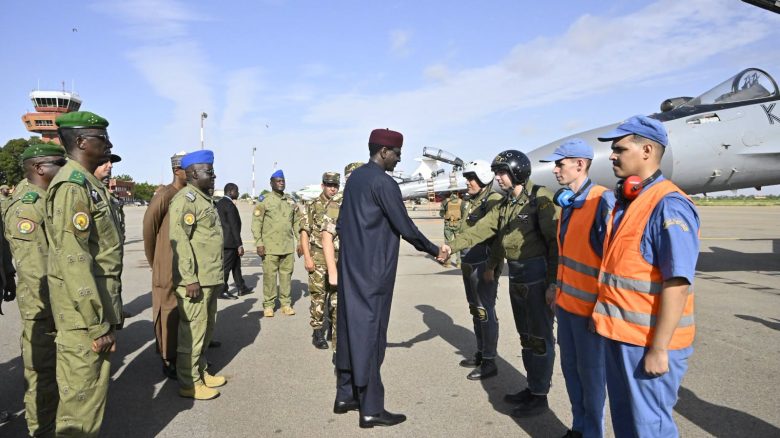
In a decisive message sent to its immediate neighborhood in the Sahel, Algeria has broken with a long-standing military defense doctrine. Following a mutiny or coup attempt in Niger, Algeria dispatched two patrols of Sukhoi Su-30 fighters (four aircraft in total) to Niamey, alongside a refueling aircraft and a transport vessel.
These warplanes were deployed “in accordance with instructions from the President of the Republic, Abdelmadjid Tebboune, Supreme Commander of the Armed Forces and Minister of National Defense,” according to a Ministry of National Defense (MDN) statement. The dispatch of these combat assets comes in response to an official request from Nigerien authorities.
The objective behind deploying these fighter jets focuses on “strengthening strategic cooperation” between Algeria and Niger across “various sectors, particularly military,” following “the tragic events that recently occurred in Niamey as part of an attempt to destabilize the country,” the same source added. The two patrols of Sukhoi Su-30 fighters will be tasked with supporting the Nigerien armed forces to counter this destabilization effort.
According to the MDN, “this operation reaffirms Algeria’s unwavering commitment and determination to pursue its efforts to strengthen security and stability in the region, while renewing its steadfast support for the Nigerien government and people to overcome this sensitive period.”
Last Saturday, Algiers condemned the coup attempt in Niger and extended its backing to Nigerien authorities within the context of deepening ties between both nations.
This aerial support comes just days after the deployment of four combat helicopters to Niger, a nation confronting assaults from terrorist groups alongside destabilization maneuvers and foreign interference.
The President of the Republic, Abdelmadjid Tebboune, held a telephone conversation Monday with his Nigerien counterpart, General Abdourahamane Tiani, to inquire about conditions in the neighboring country. During this exchange, President Tebboune commended and thanked his Nigerien counterpart for efforts made to thwart the attempt to destabilize Niger.
For his part, President Abdourahamane Tiani reassured the Algerian Head of State, asserting that conditions were “entirely under control.” He also expressed gratitude to Algeria for its constant support toward Niger and its people.
Mr. Tebboune renewed Algeria’s pledge to stand beside Niger, its population, and its institutions, reiterating Algiers’ backing for the brotherly nation in all fields and under all circumstances.
On this occasion, both Presidents reviewed progress on joint projects agreed upon during President Tiani’s recent visit to Algeria. These initiatives are viewed as a vital catalyst to accompany and accelerate Niger’s development.
For his part, the Prime Minister of Niger, Ali Mahaman Lamine Zeine, voiced Sunday evening in Niamey his nation’s deep appreciation for Algeria’s gesture. “Algeria considers that everything necessary to help secure our safety and promote our sovereignty constitutes a top priority,” he stated, welcoming “this act that deepens cooperation between the two countries.”
The deployment of multirole combat aircraft by Algeria to Niger is described by observers as a major evolution in Algerian strategic posture across the Sahel region. Beyond political support, bilateral military cooperation has taken on a fresh strategic dimension.
This Algerian aerial detachment is set to provide low-altitude firepower, ground troop support, interception capabilities, and long-range strike capacity across a vast desert territory that has become a breeding ground for terrorist groups.
It is worth emphasizing that Algerian assistance to Niger is neither accidental nor opportunistic, given that both nations share a border spanning over 900 kilometers. The destabilization of this neighboring state is now viewed as a direct threat to Algerian national security.
Since independence, and apart from deploying NLA units during the two Arab-Israeli wars in 1967 and 1973 in Egypt, Algeria’s doctrine rested strictly on a strategy of deterrence, defense, border security, and intelligence sharing.
However, observers note that Algeria’s decision primarily answers a strategic concern across a vast region extending from western Sudan to Mali, passing through Chad, southern Libya, and northern Nigeria—an area marked by violent armed groups allied with transnational trafficking and arms smuggling networks. This zone also sits at the center of complex rivalries among several powers and foreign interests.
Such systemic instability poses a severe threat to major economic endeavors recently launched by Algeria in Niger, most ambitious among them being the 4,000-kilometer Trans-Saharan Gas Pipeline, energy programs, the Trans-Saharan Highway, trade flows, and the fiber optic network.
It is no coincidence that President Tebboune declared during Abdourahamane Tiani’s recent visit to Algeria that both nations stood “in the same trench,” pledging to mobilize Algerian capacities and expertise.