

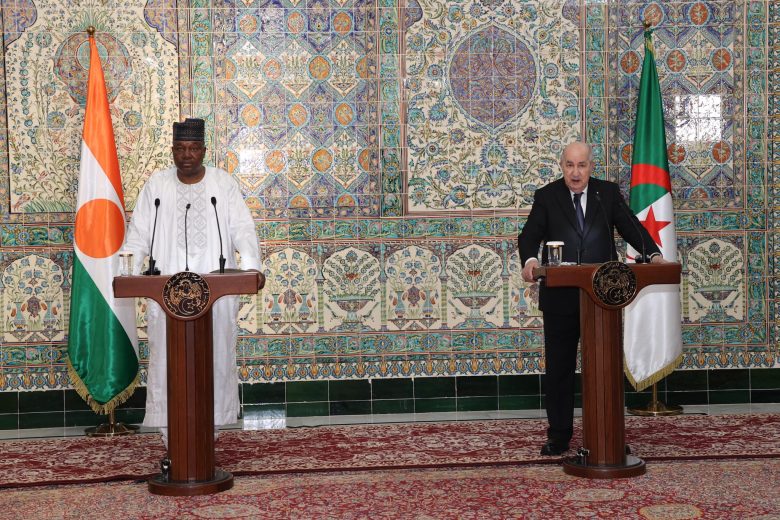
President of the Republic Abdelmadjid Tebboune announced this Monday, during a joint press conference with his counterpart from the Republic of Niger, Army General Abdourahamane Tiani, the revival of a multidimensional strategic partnership with Niger, marking a political warming at the highest levels.
President Tebboune stated that this visit “puts an end to an unnatural phase of coolness in bilateral relations,” specifying that “the two brotherly peoples have continued to communicate.” The head of state highlighted the fraternal dimension of this rapprochement, estimating that the meeting “elevates the level of fraternity and friendship between us, as neighbors, brothers, and friends,” reflecting a shared will to refocus relations on solidarity and common history, through a dense agenda centered on security, energy, and training.
Regional security was a major axis at the heart of the discussions. The Sahel, faced with instability and the terrorist threat, requires strengthened cooperation. “The security of Niger is the security of Algeria. We are in the same trench in all circumstances,” assured President Tebboune, emphasizing that Algeria will mobilize “all the capacities and expertise at its disposal” to support Niger in the fight against terrorism.
The two countries have thus agreed to strengthen their security collaboration, sharing intelligence and military expertise, to stabilize a region that is strategic for the entire African continent. This approach reflects a shared vision of security as the pillar of development and regional stability.
Energy constitutes another central aspect of the partnership. Algiers and Niamey have decided to accelerate structuring projects, particularly the launch of the trans-Saharan gas pipeline, which will cross Niger. “Immediately after the month of Ramadan, operational procedures will be initiated to begin laying the pipeline on Nigerien soil,” specified President Tebboune. Bilateral cooperation is not limited to hydrocarbons and electricity. It extends to university, professional, and military training, strengthening Niger’s capacity to develop its human resources while consolidating its institutions. “Algeria is ready to support its brothers in Niger in everything they need, without sparing the means at our disposal,” reaffirmed the head of state, underscoring a concrete and lasting commitment.
In addition to sovereign and economic sectors, the two leaders discussed projects with strong social impact. Health, education, and culture are integral parts of this renewed cooperation. The creation of secondary schools, the establishment of a dialysis service, and the setup of a press house in Niamey for Nigerien media illustrate a will to strengthen the social fabric and cultural dialogue.
“We preserve the affection that unites us across generations,” concluded President Tebboune, promising that “the Algerian and Nigerien peoples will remain two brotherly and neighboring peoples, united by solid bonds.” An affirmation that resonates as a call for stability and cooperation throughout the Sahel.
For his part, President Tiani declared: “Our presence today reflects the importance we attach to strengthening fraternal and cooperative relations between our two peoples, our two governments, and our two countries.” “I particularly want to express my pride in the solidity of the historical relations that unite our two peoples and in our shared will to inject new momentum into our fraternal cooperation and good neighborliness,” he added.
Highlighting Algeria’s central role in preserving Niger’s sovereignty, the Nigerien president stated that “Algeria’s position in favor of respecting Niger’s sovereignty and its internal political choices is an honorable position for your government and for the great Algerian people.” He added that no “African can imagine that Algeria, which suffered for over a century from the torments of colonialism, could allow its territory to be used to attack a brother African country.” He also emphasized the responsibility of each African country, affirming that “we are convinced that an important page in the history of the Sahel and Africa is being written today and that each country will choose its position according to its convictions, its interests, and the values it believes in.” He concluded by stating that “it is in this spirit that we have come to your brotherly, friendly, and neighboring country.”