

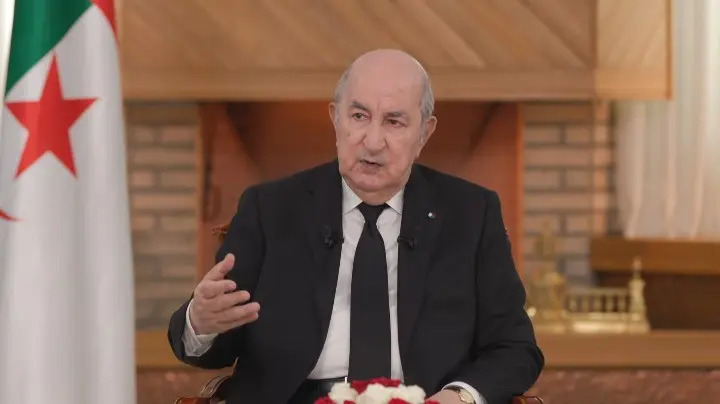
The country’s economic situation, between achievements and prospects, was reviewed by the President of the Republic, Abdelmadjid Tebboune, who set the course for the coming years. From the exploitation of mineral wealth to connecting all regions of the country through a national rail transport network under expansion, including the performance of non-hydrocarbon exports, the President—who once again ruled out any recourse to external debt—reiterated the commitment to maintaining the social character of the State.
During his periodic meeting with representatives of the national press—an exercise during which he addresses all political, economic, social questions as well as international relations—the President of the Republic was first called upon to comment on the flagship economic news: the commissioning of the West Mineral Line (Gara Djebilet-Tindouf-Bechar). A national project of great scope aimed at exploiting the country’s mineral wealth, affirmed the President, specifying that this rail line “is only the beginning of a national project of great scope aimed at exploiting the country’s mineral wealth.” “These are the first steps of an emerging country,” he emphasized, expressing his pride in seeing this project come to fruition “with national capacities in record time.” This proves that Algeria is a “country of exploits,” he said, “despite attempts to question the national construction process.”
In the east of the country, another major project is underway. This is the East Mineral Line connecting the Bled El-Hadba mine to the port of Annaba, which now mobilizes all available means. The President of the Republic indeed affirmed that after completion of the West Mineral Line, “all national capacities in rail project implementation will be mobilized for this line,” specifying that “out of a total of 450 km, only 150 to 175 km remain to be finalized, within a timeframe of one year or a little more.” Algerian phosphate will be loaded at the mineral quay of the port of Annaba “from the end of 2026 to the end of the first half of 2027,” he added.
Furthermore, the President specified that the national rail transport network is being expanded to reach the far south of the country, with the Alger-Tamanrasset line scheduled for operation in 2028, while the network will reach Adrar “between the end of 2026 and the first half of 2027.”
============End of Iron Ore Imports Within Three Years
The head of state returned to the strategy adopted for exploiting the country’s mineral resources. In this regard, he indicated that the lead and zinc mine project at Oued Amizour, in Bejaia province, will be launched before the end of the first quarter of 2026.
“The next phase, after the launch of the West mineral rail line last week, will concern the Oued Amizour mine, where the first drilling works will begin at the end of March,” he noted. “We are now on the verge of launching the project with the agreement of the citizens living in the region,” he affirmed, emphasizing that the regularization of the situation with landowners is in its “final phase.”
President Tebboune highlighted the strategic importance of exploiting the Gara Djebilet iron ore mine, a highly profitable project that will save 1.5 billion dollars currently spent on importing iron ore for the steel complexes in Oran, Jijel, and Annaba. In the long term, the project aims at exports and could partially compensate for hydrocarbon revenues. According to studies conducted by international firms, the project is feasible and economically viable, despite criticisms questioning its utility. It should end iron ore imports within a maximum of three years, boosting development in the Southwest of the country.
=================5 Billion Dollars in Non-Hydrocarbon Exports
President Tebboune affirmed that Algeria’s GDP will exceed 400 billion dollars by the end of 2027, highlighting the rapid and encouraging evolution of the national economy. He also spotlighted achievements in economic diversification, particularly non-hydrocarbon exports which reached 5 billion dollars—a “miracle” compared to the previous 1.5 billion. He denounced the “war waged against Algeria” in terms of exports, citing European quotas imposed on rebar, and the difficulty of obtaining consensus on renegotiating the association agreement. Regarding external debt, Tebboune reaffirmed the sovereign choice not to resort to it, specifying that any external financing will be done “according to a rational vision” and only for high-return economic projects.
In this regard, he specified that Algeria benefits from financing from the African Development Bank (AfDB) worth more than 3 billion dollars, intended for the rail line extension project toward El-Menia and Ghardaia, “with flexible repayment possibilities spread over 13 years.”
He further observed that Algeria can benefit from AfDB services, especially as it is one of the founding members and main contributors, emphasizing that the proposed financing conditions are flexible, as the AfDB is an African institution created to support the development of member states and not a private entity.
The President also insisted on exploiting these financings according to a rational vision, parallel to structuring projects entering their profitability phase, adding that Algeria “will not mortgage the future of its children through debt and will never renounce the independence of its decision-making.”
===========No Toll on the East-West Highway
Regarding the inflation rate, the President of the Republic specified that it has dropped from nearly 11% in 2019 to less than 1.8%, describing this evolution as a “miracle in the current context,” compared to other countries experiencing price surges.
On the question of introducing tolls on the East-West highway, the President ruled it out by expressing his current refusal to impose tolls for using the East-West highway, in order to preserve citizens’ purchasing power, adding that inter-provincial transport of essential goods takes place on this road axis.
The President of the Republic emphasized that Algeria is a “social state” that allows business freedom but “at the same time watches over the protection of the working class, within a framework of national solidarity ensuring prices within citizens’ reach.”
President Tebboune highlighted the “social character of the State” and the need to direct support toward the most needy. He announced the establishment of a new social policy, based on digitization, to be implemented by the end of 2026 and beginning of 2027. This approach will be overseen by a national commission including parties and unions, with the aim of achieving “true social justice,” an balance that has not yet been realized to date.