

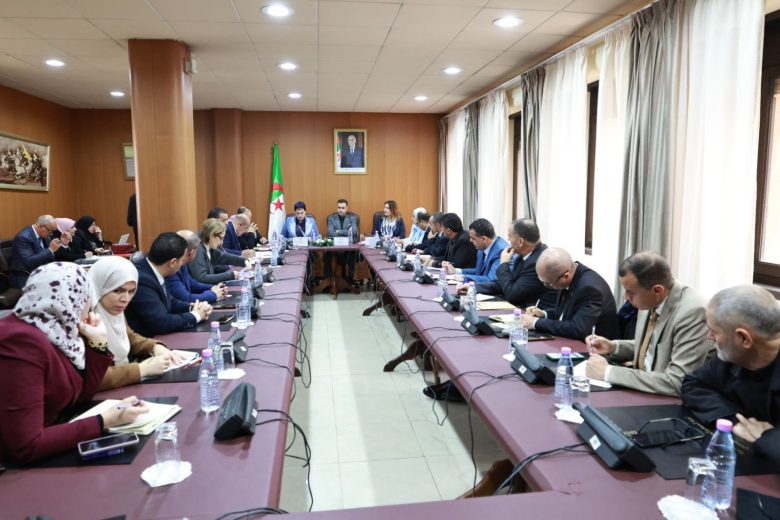
Completion of regulatory texts, new national structures, comprehensive social mapping, and strengthening of social investment—these are the main points presented by the Minister of National Solidarity, Family, and Women’s Conditions, Soraya Mouloudji, before the Health, Social Affairs, Labor, and Vocational Training Commission of the National People’s Assembly (APN).
Ms. Mouloudji presented to the commission an ambitious roadmap for social policy in 2026, stating that the priorities for the current year are the completion of application texts for the initiated reforms, the creation of new national structures, the development of a comprehensive social map of the country, and the strengthening of social investment.
In this context, the minister announced this Monday the inclusion of 18 new investment operations, as well as 66 rehabilitation and equipment operations for specialized establishments, with a total financial envelope exceeding 1.5 billion dinars.
Ms. Mouloudji took care to affirm that her department is working to sustainably consolidate social gains through a comprehensive sectoral policy based on precise targeting, transparency in management, and updating of legal and regulatory frameworks, in coherence with the program of the President of the Republic. She emphasized that the objective is to guarantee a dignified life and strengthen social and economic inclusion.
The minister recalled that the protection of people with specific needs remains a strategic priority. In this regard, she highlighted Law No. 25-01 of February 20, 2025, which enshrines an integrated approach combining prevention, social protection, and judicial protection, while ensuring access for this category to all areas of life. Twelve regulatory texts have been prepared to ensure the effective implementation of this law.
In the extension of these reforms, the conditions for access to the flat-rate solidarity allowance have been revised in favor of people with specific needs without income, allowing an expansion of the number of beneficiaries.
In terms of specialized education and teaching, the sector currently has 242 establishments and 30 annexes, in addition to the opening of 1,645 school integration classes during the current school year. A joint ministerial circular has been issued to ensure the continuity of the flat-rate solidarity allowance benefit for young people with specific needs during their orientation toward vocational training.
Reduction Raised to 80% and Generalized Free Transport
Ms. Mouloudji indicated that a National Autism Center has been created by presidential decree, alongside preparations for the launch of specialized centers at the national level and training programs for professionals and associations.
In terms of professional and economic integration, the minister reported the support for thousands of projects for people with specific needs, notably through the launch of an electronic guide dedicated to economic integration. This is complemented by the mobilization of more than 1.06 billion dinars in 2026 for the acquisition of equipment and technical aids. Transport benefits have also been strengthened, with reductions raised to 80% and the generalization of free urban transport.
Addressing family and women’s issues, Ms. Mouloudji recalled the launch of a national plan for family protection and promotion, supported by the creation of 229 listening and orientation spaces across 58 wilayas, backed by the Sanadoukom digital platform. She also mentioned the Productive Family program for families without income, as well as the Taswiq platform dedicated to marketing products from rural women.
In the framework of women’s empowerment, the minister highlighted the installation of the National Family and Women Council, the implementation of economic integration programs, and the deployment of a national strategy for protecting women victims of violence for the 2025-2030 period, supported by the Himayati platform.
The minister concluded her presentation by assuring the continuation of efforts in caring for the elderly, child protection, support for assisted children, and payment of the school allowance to students from needy families, alongside the expansion of social development programs led by the Social Development Agency.
During the debate, commission members called for a shift from a solidarity-based approach to a rights-based one, raising several concerns related to the revaluation of social allowances, improving working conditions for sector workers, child protection, and adapting social policies to social changes and the high cost of living.
Among other proposals, parliamentarians advocated for greater support for rural women, granting microcredits to housewives, addressing housing issues for divorced women and widows without income, and revising the Ramadan couffin allowance.
Parliamentarians also called for expanding psychopedagogical centers, creating listening cells for families in conflict, and providing legal frameworks for child protection against new forms of exploitation.