

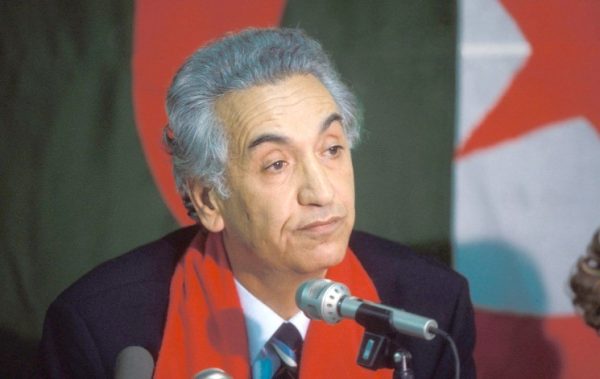
The Socialist Forces Front (SFS) kicked off an international colloquium dedicated to Hocine Aït Ahmed, a leading figure in the struggle for independence and the building of democracy, this Saturday at the Higher School of Hospitality and Catering (ESHRA).
Renowned Algerian and foreign historians and university researchers, including Benjamin Stora, gathered in Algiers alongside national and international political actors, militants, and citizens to take part in this colloquium in homage to Hocine Aït Ahmed. In presiding over this event, the national first secretary of the SFS, Youcef Aouchiche, stated by way of introduction that this homage responds, first and foremost, to a requirement of transmission, which he described as a “historical duty,” in the face of attempts at instrumentalization and simplistic rewriting of national history.
For the SFS’s first secretary general, transmitting history does not mean sacralizing it or freezing it, much less instrumentalizing it for short-term purposes. In plain terms, he emphasized, history must never become a circumstantial narrative or a tool of legitimation, but must remain an indispensable field of critical knowledge, “to shed light on past struggles and understand the dead ends as well as the hopes of the present,” he affirmed. “Transmitting means refusing any artificial break between the past and the present, which in reality conceals a desire to depoliticize society,” he added.
At the heart of this work of memory, the speaker recalled that “the historic leader of the Revolution conceived independence not as a mere transfer of territorial sovereignty, but as a global liberation, both political, social, and moral.” Belonging to the founding generation of independent Algeria, Hocine Aït Ahmed, he specified, envisioned the Revolution as the prelude to a state of law, a democratic and social republic centered on justice and popular sovereignty.
In the same vein, Youcef Aouchiche traced the journey of a courageous, visionary politician who was engaged for more than seven decades in a structured struggle, sometimes solitary, but always faithful to his convictions. A humanist, anticolonialist, and staunch defender of democratic freedoms, nourished by a universal political culture, Hocine Aït Ahmed constantly linked thought and action, morality and politics, he declared. “Hocine Aït Ahmed never sought the comfort of a fake consensus,” he recalled.
According to the SFS official, Hocine Aït Ahmed opted for the demanding pursuit of a true national consensus based on national unity, civil peace, as well as national and popular sovereignty. As a long-time militant for democratic principles in Algeria, Hocine Aït Ahmed viewed these principles not as an imported model, but rather as a universal requirement deeply rooted in the history and customs of North African peoples, the SFS’s first secretary general indicated.
In an international context marked, according to the SFS official, by the resurgence of imperialist logics and the degradation of the sense of political commitment, the same speaker felt that revisiting Hocine Aït Ahmed’s journey amounts to rekindling the spirit of independence in all its dimensions. The values carried by the historic leader of the SFS remain, in his view, an essential compass for current and future generations.
Over two days, this scientific gathering will feature cross-analyses and in-depth academic debates around Hocine Aït Ahmed’s journey. The ceremony also includes an inaugural lecture by Mustapha Ben Jaâfar, honorary president of the Socialist International, and the naming of the SFS’s national headquarters in Algiers after Hocine Aït Ahmed, in addition to interventions by Gilles Manceron, Aïssa Kadri, and Smaïl Tahi. Among the interventions in the first session were also Mohamed Lahcen Zeghidi, Benjamin Stora, Amar Mohand-Amer, Ali Guenoun, Ouanassa Siari Tengour, Fouad Soufi, and Mostefa Bouchachi.