

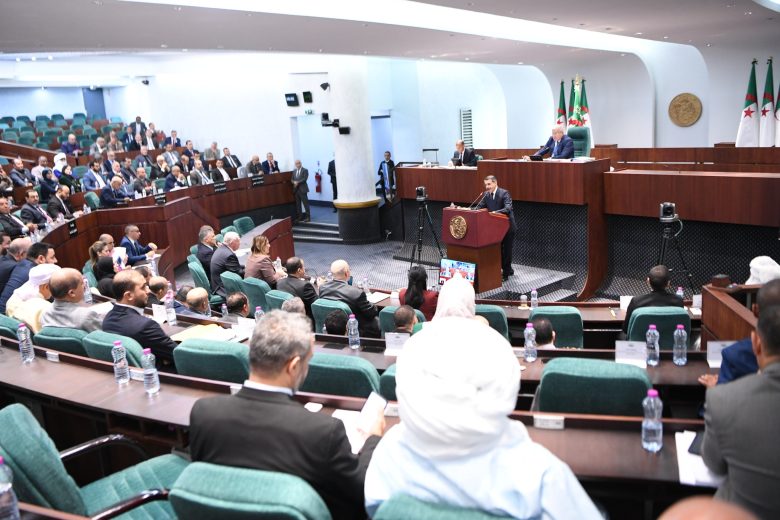
Debates on the 2026 Finance Bill (PLF) began this Sunday at the National People’s Assembly (APN) and will continue until tomorrow, with night sessions due to the large number of registered speakers, totaling 258. The initial interventions by the elected representatives ranged between approval of the bill and reservations about certain provisions of the law.
After the presentation of the 2026 Finance Bill by the Minister of Finance, Abdelkrim Bouzred, before the members of the lower house of Parliament, in the presence of several government members, as well as the report from the APN’s Finance and Budget Committee, the floor was given to deputies to debate the bill that sets the State’s budget for the year 2026.
The first deputy to speak, Slimane Zerkani of the Movement of Society for Peace (MSP), questioned the means and tools that would help close the budget deficit. According to him, the 2026 Finance Bill does not include these mechanisms, although he praised the government for preparing the bill within the allotted time. The fact that only 70% of the previous finance law was spent “is not an achievement but a dysfunction,” calling for the reallocation, at least partially, of unforeseen expenses towards financing local development projects.
Independent deputy Mohamed Anouar Bouchrit, for his part, praised the provisions of the Finance Bill. However, this evaluation did not prevent him from mentioning some “shortcomings.” Stating that this bill is not merely “a technical operation,” he stressed the need to make the bill “a starting point for a productive economy that will generate added value.”
He emphasized the need to activate economic development mechanisms that will produce the expected effects throughout various sectors, encourage productive investments that create wealth, highlighting the country’s great potential. This, however, is not sufficient according to the independent deputy, who calls for the removal of administrative obstacles and bureaucratic practices, particularly through digitization of the tax system.
Deputies from the National Liberation Front (FLN) also intervened during this first debate session. Praising the country’s financial policy, Zakaria Bedroun highlighted the fact that the principle of preserving the State’s social character “with measures that improve citizens’ purchasing power” was not abandoned, in addition to encouraging investment. The dedication of a larger budget within the 2026 Finance Bill reflects “the president of the Republic’s determination to continue development efforts.”
This observation does not prevent him, however, from raising some remarks mainly related to the allocation of economic land. According to him, “thousands of investors await the allocation of land to realize their projects,” also calling for a revision of the subsidy system and the establishment of fair taxation.
Riadh Henachi from the same political formation noted the particular context in which the 2026 Finance Bill was established, which did not prevent, he affirmed, “preserving citizens’ purchasing power,” “improving the business climate,” and “controlling major financial balances.”
Certain points, however, need to be improved, Mr. Henachi noted, mentioning the absence of indicators to evaluate the achievement level of fixed objectives while recommending digitization of the tax system. He advocated establishing a unified system that groups different concerned services, such as taxes, customs, and the CNRC, to reduce tax evasion and increase State revenues.
For independent deputy Brahim Aftouche, more funds are needed to finance various development and investment projects. Noting the dependence on hydrocarbon revenues, the independent member stressed the need to continue diversifying the national economy. “It is time,” he added, “to restart the economic engine and diversify revenues,” also noting the clarity offered by the establishment of the finance law under Law 18-15.