

The President of the Republic wants a “definitive organisation” of the agricultural sector. This directive was given during the Council of Ministers, calling for the preparation of a new agricultural orientation bill according to a forward-looking vision involving specialists. This orientation signals a change of course for the agricultural sector, based on a new approach primarily focused on modernity and innovation to align the sector with the new agricultural strategy.
The agricultural sector is called to “undergo its transformation.” This is the direction given by the President of the Republic, Abdelmadjid Tebboune, who ordered, during the Council of Ministers he chaired the day before this Monday, to “prepare a new agricultural orientation bill for a definitive organisation of the sector based on a forward-looking vision involving specialists.” For agricultural expert Boukhalfa Laala, the President, through the call to prepare a new bill, “is referring to the National Conference on the Modernization of Agriculture,” which, it should be noted, ended with the adoption of a set of recommendations focused primarily on the need to digitize production techniques, adopt modern irrigation methods, and encourage local seed production through the creation of specialised national hubs.
Mr Laala, who noted the great importance for the agricultural sector given that it is often on the agenda of Council of Ministers meetings, stressed the need to implement new measures capable of aligning the sector with the new agricultural strategy adopted by the public authorities, which gives particular attention to the development of strategic crops and thereby guarantees the country’s food security.
“It is now necessary to implement new measures to change direction, allowing a shift from traditional agriculture to modern agriculture,” he specified, underlining the need to address the various issues raised by sector professionals. In this regard, he mentioned bureaucratic practices which, according to him, “dominate the sector,” as well as the lack of coordination between the different structures.
According to the agricultural expert, who emphasised the necessity to introduce new technologies in the management of the sector, the new legal framework announced aims to “review the organisational chart and functioning of the Ministry of Agriculture, from top to bottom, as well as the functioning of the sector’s structures.”
In addition to wanting to organise the sector definitively according to a new approach, the President of the Republic called for the involvement of specialists. This approach is already taking shape with, it should be recalled, the establishment of a Scientific Council for Food Security, alongside the National Conference on the Modernization of Agriculture, which is composed of 34 members representing different sectors.
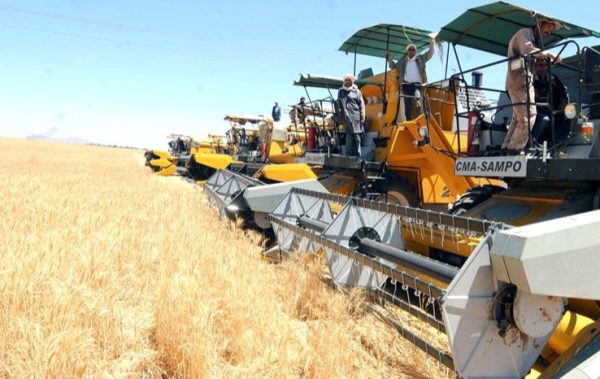
Another new measure has also been taken by the President of the Republic in favour of the agricultural sector, related to the import of new equipment. The Head of State instructed the Minister of Agriculture, Rural Development and Fisheries to coordinate with the Minister of Foreign Trade and Export Promotion to proceed immediately with the import of harvesters and seeding equipment, with the possibility of importing machines less than five years old for harvesting maize and oilseed crops, including sunflower.
This measure is timely, according to Mr Laala, with the ambition to increase productivity and improve yields. It will also significantly reduce production costs. “The import of modern agricultural equipment is very important,” he affirmed, noting that currently, “we are using traditional agricultural equipment.” “To increase yields, it is essential to provide farmers with equipment that meets the conditions of modern agriculture,” he added. The importation of new harvesters is particularly important, as this equipment will help eliminate losses, which until now, according to Mr Laala, have been estimated at 12%.