

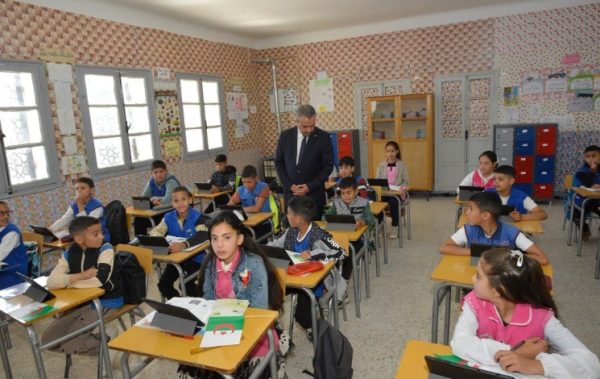
Four weeks after classes resumed, the 2025-2026 school year stands out for its rigorous organization and calm atmosphere. Thanks to exemplary mobilization from all stakeholders in the education sector, students returned to their classrooms under optimal conditions. The school year has been described as “successful” and “well-managed” by education professionals, despite some ongoing challenges.
Contacted by Le Jeune Indépendant, education advisor Kamel Nouari stated in his assessment that the school year started “safely, calmly, and successfully on all fronts.” According to him, the success of a school year is primarily measured by the education system’s ability to ensure, from day one, a place and a teacher for every student.
This means, he explains, that all conditions for welcoming, supervising, and schooling have been met, with a focus on fairness between wilayas and equal opportunities for all students. The goal, he adds, is to provide quality education and promote academic success through the involvement of all actors in the sector.
This view is shared by several teachers in the field. “Unlike previous years, everything was ready before school started. Syllabi, teaching materials, and even timetables were available on time,” testifies T. Saliha, an Arabic language teacher at a middle school in Boudouaou. She adds, “Students returned in a peaceful environment, without chaos or delays. There is a noticeable improvement in coordination between ministry services and schools.”
Several positive aspects marked this school year, reflecting rigorous preparation and a continuous improvement mindset for the education system. These include guaranteeing schooling for all children aged six in accordance with the law, continuation of compulsory education until age 16, and until age 18 for children with special needs, expansion of preschool education, distribution of new first-year middle school programs including English, and compliance with requirements regarding school supplies.
Additionally, electronic tablets were made available in primary schools before the start of the school year, the school allowance of 5,000 DA was paid early before the end of July, all textbooks were available in schools and bookstores, school cafeterias opened on the first day with guaranteed hot meals, and school health units were reopened with medical and paramedical teams.
Furthermore, the organization of a National School Health Week under the theme “School Health… for a Healthy and Safe Future” helped raise awareness among students and staff on the importance of physical and mental well-being in the educational environment. Finally, the digitization of many administrative procedures — including registrations, transfers, and changes — through dedicated platforms has greatly simplified sector management and enhanced the transparency and efficiency of public education services.
Despite these advances, Mr. Nouari acknowledges that class overcrowding remains an issue in some areas, mainly due to a lack of classrooms. To address this, temporary solutions such as split shifts have been implemented.
He calls for the swift adoption of the executive decree setting out the terms for opening private educational institutions, believing that this measure will help ease congestion in public schools, especially in large urban areas.
“The success of this school year is primarily that of the educational community, which has demonstrated commitment and professionalism,” the advisor emphasizes. He also commends the Ministry of National Education for meeting this second challenge following the success of the end-of-year exams.