

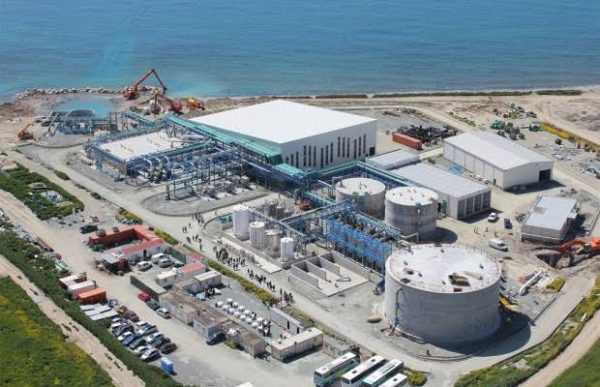
On Thursday, the Sonatrach Group announced that the Cap Djinet 2 seawater desalination plant, located in the province of Boumerdès, is now operating at full capacity. The facility now has an operational capacity of 300,000 m³ per day, equivalent to 300 million litres of desalinated water per day, following the completion of all technical tests and quality controls.
This strategic infrastructure came into service on Thursday morning, following a rigorous technical and experimental process that began with its official inauguration by the President of the Republic, Abdelmadjid Tebboune, on 11 March 2025. According to a statement from Sonatrach, this commissioning follows ‘extensive mechanical and technical tests, as well as strict quality controls,’ ensuring full compliance with international safety and efficiency standards.
The group points out that this achievement illustrates the success of the national approach to mobilising local skills and promoting their expertise. The plant was designed and built in all its phases by the National Oil Works Company (ENGTP), a subsidiary of Sonatrach, from the initial engineering studies to full commissioning. This feat confirms the company’s ability to carry out major projects that meet international standards.
Through its subsidiary Algerian Energy Company (AEC), Sonatrach has also reaffirmed its commitment to implementing the first complementary national programme aimed at strengthening the country’s water security ‘in record time’. This programme reflects Algeria’s determination to effectively address the challenges associated with water resources.
For Sonatrach, the Cap Djinet 2 plant represents ‘a major strategic achievement, consolidating national water sovereignty and illustrating the group’s leadership role in carrying out structural projects that promote sustainable development and the national economy.’
Algeria is actively developing its seawater desalination capacity to address water scarcity and climate change. The country has commissioned several plants, with a strategy to increase the share of desalination in national water consumption to 60% by 2030.
Last August, the Sonatrach group also announced that the large seawater desalination plant at Koudiet Eddraouch (El Tarf) had entered full production, with an estimated capacity of 300,000 m3 per day.
At the same time, Algeria has invested heavily in the construction of dams and the development of hydraulic interconnection networks to ensure a more equitable distribution of water resources between different regions. The country now has more than 80 dams, offering a storage capacity of 8.3 billion cubic metres, which is expected to reach 12 billion cubic metres by 2030. South-South and South-North transfers have enabled the establishment of an integrated water network, thereby consolidating national water solidarity. The drinking water connection rate now stands at 98%, placing Algeria among the African countries with the best water access infrastructure.
In line with this strategy, six new desalination plants will be built from 2026 onwards in the wilayas of Skikda, Jijel, Tizi Ouzou, Chlef, Mostaganem and Tlemcen, each with a capacity of 300,000 m³/day. The aim is to increase coverage to over 60%, while preserving groundwater resources. At the same time, Algeria aims to develop desalination technologies locally, particularly reverse osmosis membranes, and to make greater use of renewable energies to power these facilities.