

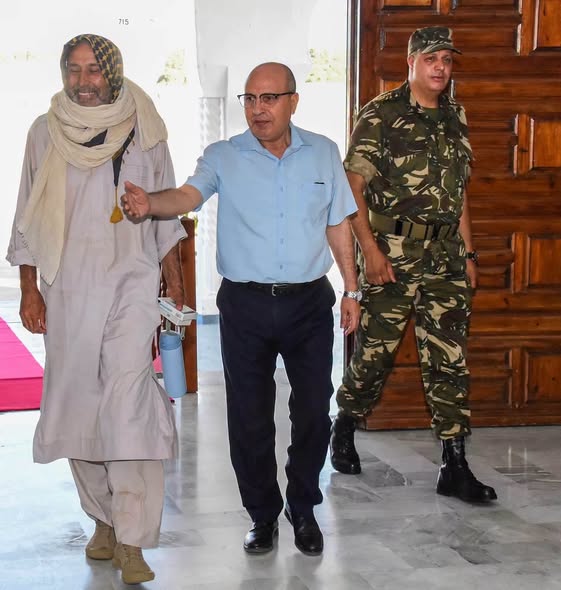
Freed after being kidnapped in Niger by an armed criminal group, German national Ulumaskan Sinan was officially handed over on Monday to his country’s authorities in Algiers. This operation unfolds within a Sahelian context marked by the persistence of armed groups and criminal networks, while Algiers maintains a firm stance against kidnappings and ransom payments. This was stated by Lounes Magramane, Secretary General of the Ministry of Foreign Affairs.
Magramane praised the role of Algerian institutions in resolving the case, declaring during the handover ceremony held at the Ministry of Foreign Affairs headquarters—in the presence of the German Ambassador to Algeria, Georg Felsheim—that “these positive developments crown the efforts made by Algerian state institutions, particularly the security services under the Ministry of National Defense, to whom we express our full gratitude and appreciation for their contribution to the release of the German national.”
On this occasion, Magramane revealed that Ulumaskan Sinan was transferred Friday evening under optimal conditions from the secondary deployment base in In Guezzam to the Boufarik Air Base. Algerian authorities subsequently verified his health status and kept their German counterparts informed of developments until his safe return home.
The German side expressed appreciation for Algeria’s efforts. The German Ambassador to Algeria, Georg Felsheim, voiced his “thanks and gratitude to the Algerian authorities for all the efforts deployed and for their pivotal role in allowing the German national to regain his freedom and return to his country.”
Ulumaskan Sinan also expressed his personal gratitude to Algerian authorities and the People’s National Army (ANP) for the operational efforts that led to his release.
Beyond the individual case of the German national, this operation serves as a reminder of Algiers’ consistent position regarding kidnappings and terrorism financing.
The outcome underscores the long-standing posture advocated by Algiers on hostage situations. For authorities, freeing hostages fits into a broader strategy that simultaneously aims to prevent hostage-taking from becoming a revenue stream for terrorist outfits.
In this regard, Magramane recalled the mobilization of various state services in such operations, citing “numerous other hostage release operations conducted in the past.” He asserted that “drawing strength from its experience and history, Algeria will always continue to confront all forms of violent extremism, criminal and terrorist acts, as well as the abhorrent practice of kidnapping and ransom payments.”
The Stake of Regional Security
This security doctrine is complemented by diplomatic engagement led by Algiers on the international stage. Notably, Algeria contributed to drafting the Algiers Memorandum on Good Practices on Preventing and Denying the Benefits of Kidnapping for Ransom by Terrorists, adopted within the Global Counterterrorism Forum.
This principle was subsequently enshrined at the UN Security Council through Resolution 2133, adopted on January 27, 2014. The text condemns kidnappings aimed at securing funds or political concessions and calls on states to prevent terrorist groups from benefiting from ransoms.
The issue of kidnappings cannot be isolated from the broader security environment in the Sahel. The movement of armed groups and criminal networks across border zones exposes multiple nations to threats that inherently transcend national frontiers.
“What harms neighboring countries inevitably affects us,” stated Lounes Magramane, emphasizing the close link between Algeria’s security and that of its regional surroundings.
From this perspective, he affirmed that “the security, stability, and prosperity of sister and friendly nations remain central priorities of the national political and diplomatic agenda, in line with directives from the President of the Republic, Abdelmadjid Tebboune.”
Security cooperation, regional coordination, and dialogue constitute primary pillars of Algerian action in the Sahelian sphere.
The Ulumaskan Sinan file echoes another recent case handled by authorities. A few months earlier, a Spanish national was released in the southern region. Navarro Canada Joaquim, traveling as a tourist, had been abducted on January 14, 2025, near the Algerian-Malian border zone. ANP security services recovered him on January 21 in good health before transferring him via special aircraft from Tin Zaouatine to Boufarik Air Base for handover to Spanish authorities.
During the transfer of the Spanish national, Magramane had highlighted the coordinated efforts of Algerian security bodies and regional partners to achieve a resolution centered on preserving human life.
This series of operations reflects long-standing experience acquired by Algeria in managing hostage situations across the Sahelo-Saharan space. In 2003, the country faced the kidnapping of 32 European tourists, primarily Germans and Austrians, seventeen of whom were freed on May 13 during an Army operation.
Since then, various cases involving foreign citizens in the region have reinforced an approach grounded in two core principles: prioritizing the preservation of human life and refusing to let kidnappings become a financial engine for terrorist groups.