

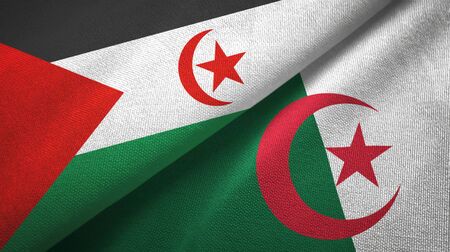
More than seven decades after the onset of the conflict, Algiers has reaffirmed its unwavering support for the Sahrawi people’s right to self-determination. During a strategic symposium hosted Monday in Algiers, speakers underlined the consistency of the Algerian stance, calling for strict adherence to international law and United Nations resolutions.
Organized jointly by the National Institute for Global Strategic Studies and the Sahrawi Center for Strategic Studies under the banner “Freedom is a universal right, and whoever usurps it is a criminal,” the gathering provided a platform to assess the issue. Addressing the opening session, the Ambassador of the Sahrawi Arab Democratic Republic (SADR) to Algeria, Khatri Addouh, praised Algeria’s persistent efforts to “keep the Sahrawi cause alive in memory and active in public conscience.”
The Sahrawi diplomat emphasized that this position “stems directly from the spirit and principles of the glorious November Revolution,” noting that it reflects the “culture of liberation and freedom” deeply rooted in the Algerian nation.
Mr. Addouh described the gathering as a renewed testament to Algeria’s support for the Sahrawi cause under the leadership of President Abdelmadjid Tebboune. He added that the symposium offers “a rich contribution” toward analyzing the historical trajectory and liberation struggle of the Sahrawi people across its seventy-year span.
Representing the Ministry of Foreign Affairs, Nassima Baghli, Director General for Strategic Monitoring, Crisis Prevention and Management, emphasized that Algeria’s position on the Western Sahara issue “has consistently remained coherent and clear,” treating it explicitly as an unfinished decolonization process. She asserted that any final settlement must occur through “the Sahrawi people exercising their right to self-determination,” in full alignment with UN charters and resolutions.
Meanwhile, the Director General of the National Institute for Global Strategic Studies (INESG), Abdelaziz Medjahed, noted that the symposium’s agenda allows for exploring the Sahrawi file from multiple analytical angles while opening space for debate on recent developments. He described the matter as a “question of global conscience,” arguing that it extends beyond the Sahrawi population to touch “all freedom-loving nations worldwide.”
The President of the Sahrawi Center for Strategic Studies, Sidi Mohamed Aba Mohamed, reiterated that Western Sahara remains “a decolonization file listed on the UN agenda.” He urged international bodies to accelerate the implementation of binding legal decisions and enable the Sahrawi population to exercise their self-determination rights.
Furthermore, he called on the United Nations to “expedite the completion of the decolonization process in Western Sahara” and empower the United Nations Mission for the Referendum in Western Sahara (MINURSO) to fulfill its mandate according to the original settlement plan.
Mr. Aba Mohamed concluded by calling on the African Union to uphold its Constitutive Act—specifically the principle regarding the respect of borders inherited upon independence. He also urged the European Union to refrain from concluding trade or resource agreements encompassing Western Saharan territory in violation of international law.