

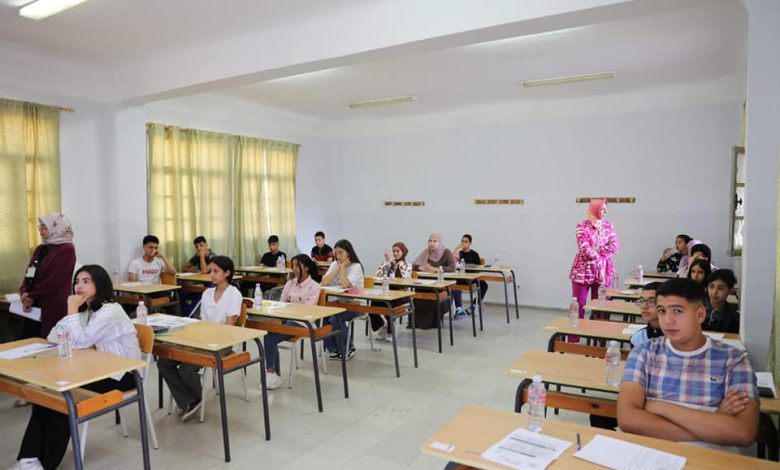
As the Middle School Education Certificate (BEM) exams kicked off on Tuesday across the nation, and with just a few weeks separating candidates from the launch of the 2026 Baccalaureate session, Algerian authorities are displaying unprecedented firmness against exam cheating and leak attempts. The judiciary, security services, and educational institutions have locked arms in a reinforced coordination effort to protect the integrity of these exams—a matter that directly impacts the credibility of Algerian schooling and the principle of equal opportunity among students.
In this context, a massive preventive and punitive apparatus has been activated, blending digital surveillance, coordination with tech platforms, and a tightening of criminal penalties. Authorities have announced sentences that can reach up to fifteen years in prison for anyone involved in leaking, broadcasting, or executing electronic fraud related to official examinations.
Public authorities have decided to reinforce electronic monitoring mechanisms to track down networks suspected of organizing or facilitating cheating. Specialized digital watch cells have been established to monitor suspicious groups, pages, and accounts active on social media networks and messaging platforms.
The newly deployed measures also include blocking websites and accounts flagged as potential sources of leaked exam topics, particularly within the perimeter of testing centers. Authorities are also counting on direct coordination with major tech companies and social media platforms to swiftly remove any content broadcasting exam questions or fraudulent answer keys.
Furthermore, competent departments have been instructed to immediately report any suspicious activity related to the publication or circulation of exam materials to the justice system. These provisions align with decisions finalized during the Interministerial Council meeting on April 28, which was entirely dedicated to end-of-year school exam preparations.
Speaking at the opening of a seminar focused on “The Criminal Protection of the Integrity of Final Middle and Secondary Education Exams: Between Prevention and Repression,” the President of the Court of Algiers, Mohamed Bouderbala, insisted on the absolute necessity of preserving the school institution’s credibility.
According to him, attacks on the integrity of exams represent a direct threat to the “scientific security of society” and to the principles of merit and competence within state institutions.
The magistrate highlighted that technological shifts, despite their benefits, have fueled the rise of new forms of criminality that exploit digital tools to disrupt the normal course of exams. In response to this reality, the state has chosen to strengthen its legal arsenal through Law 20-06, which amends the Penal Code to enforce a clear hardening of penalties against attempts to compromise exam credibility.
Even so, authorities maintain that their strategy does not rely solely on punishment. Prevention, raising awareness, and fostering a culture of merit are also top priorities. “Success cannot be built on fraud; it requires effort, discipline, and hard work,” the President of the Court of Algiers reiterated.
The penal framework outlines progressive punishments based on the nature of the offenses committed. Simple infractions carry sentences ranging from one to three years in prison, along with fines between 100,000 and 300,000 dinars when no aggravating circumstances are present.
On the other hand, penalties become drastically more severe when the acts are committed by individuals tasked with organizing, preparing, or proctoring the exams, or when they involve organized groups utilizing remote communication tools or computer systems. In those cases, sentences can jump to between five and ten years in prison, accompanied by fines reaching up to one million dinars.
Actions that lead to the complete cancellation of an exam or competition are now classified as full-fledged crimes. Under these circumstances, perpetrators face seven to fifteen years of imprisonment alongside fines ranging from 700,000 to 1.5 million dinars.
Regarding minor students caught up in cheating cases, the legal system outlines a specific approach in accordance with child protection laws.
Consequently, children under the age of ten cannot face any criminal prosecution whatsoever. Youths aged 10 to 13 are subject strictly to protective and educational interventions.
For candidates between 13 and 18 years old—the primary demographic taking the BEM and Baccalaureate exams—educational measures remain the general rule. However, reduced penalties can still be handed down in cases deemed severe, adhering to Article 50 of the Penal Code, which allows for the application of half the sentences faced by adults.