

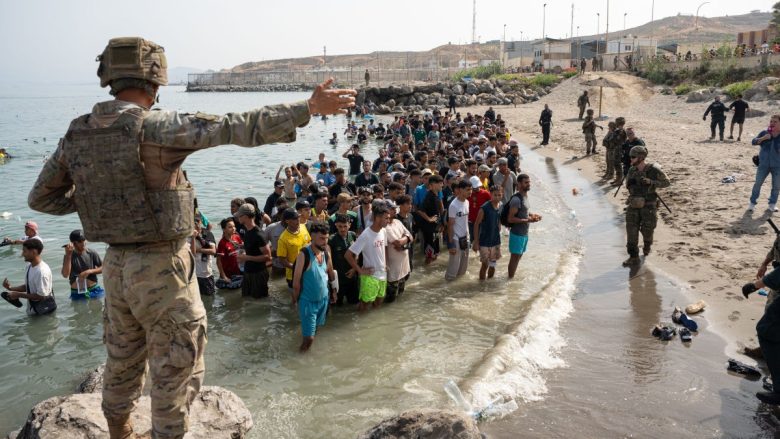
Analyzing 19 WhatsApp groups and cross-referencing data from cyberattacks allowed Spanish investigators to identify 97 links between organizers of the July 30 storming and multiple Moroccan security agencies, ranging from the Royal Gendarmerie to Moroccan intelligence services.
The judicial probe surrounding the mass migrant entry on July 30 into the Spanish enclave of Ceuta has taken a fresh turn. According to details reported by Spanish daily El Pais, citing a report prepared by the National Center for Immigration and Borders (CNIF) of the National Police, direct ties exist between Moroccan security force personnel and the digital networks that orchestrated this coordinated crossing. These findings sharply contradict an earlier assessment delivered by the National Intelligence Center (CNI), Spain’s secret service, to investigating judge Maria Tardon.
At the core of the file submitted to courts sits a thorough examination of what investigators term the event’s “digital organization.” Per El Pais, CNIF specialists sifted through 19 WhatsApp chat groups gathering 1,141 Moroccan users in total. Users were categorized based on their involvement level and operational role in preparing and coordinating the surge, though police stress a single person could perform multiple functions simultaneously.
Building on an initial technical report filed in August, detectives focused on address books of users identified as linchpins of this virtual architecture: 19 administrators and 32 “moderators” tasked with energizing chats and spreading instructions. This cross-checking isolated 97 connections to phone numbers belonging to personnel within security corps and intelligence agencies of the Kingdom of Morocco.
========Cross-Checks via Cyberattack Databases
To verify the identities and professional affiliations of those holding these phone lines, Spanish police ran open-source checks. As El Pais detailed in its November 18 edition, data pulled from contact lists were cross-referenced against a database leaked by the “Jabaroot hacktivist group,” a digital entity known for claiming and executing verified cyberattacks against official Moroccan institutions in the past.
This data matching paid off in roughly half of cases: according to the police document, “on 49 occasions, information was obtained on the probable identity” of these Moroccan service operatives. Addressing potential skepticism over using leaked digital data, the CNIF defended its methodology’s rigor. Investigators assert that technical analysis and systematic cross-referencing of available records give all queries a “high degree of likelihood and circumstantial certainty,” guaranteeing authenticity in their eyes.
=============A Broad Spectrum Within the Moroccan Security Apparatus
One of the report’s most sensitive aspects lies in the variety of entities to which identified profiles allegedly belong. Far from pointing to an isolated or local lapse, CNIF agents emphasize that the 97 detected ties are neither confined to one specific police force nor to a single administrative or territorial tier. Rather, they span a wide cross-section of Morocco’s security and intelligence apparatus.
Per elements cited by El Pais, the investigation notes the “simultaneous convergence” of officers from the General Directorate for National Security (DGSN), intelligence operatives, Royal Gendarmerie units, personnel assigned to royal palace protection, alongside staff working inside coordination rooms and traffic police units in Morocco.
Beyond the technical and security mechanics uncovered by Spanish detectives, this file implicitly exposes a cynical instrumentalization strategy pursued by Moroccan intelligence services. By infiltrating and steering these digital networks, the Kingdom’s security apparatus deliberately exploited the hardship and despair of roughly 70,000 youths, turning their socioeconomic distress into geopolitical leverage. Trapped in a behind-the-scenes operation, these would-be exiles were methodically directed and pushed onto routes leading toward Ceuta’s shores, acting as human pawns serving a political agenda beyond their control.
===========Identified Service Profiles
The CNIF highlights a “correspondence between the location of detected profiles and declared itineraries.” This territorial footprint directly overlaps primary travel corridors and overland transit routes taken by migrants, just as they described during interviews conducted by Spanish authorities after reaching Ceuta. To police, this overlap between the geographic presence of these profiles and influence zones along access routes toward the Spanish border “might not be coincidental.”
Finally, the probe uncovers a compartmentalization tactic designed to hide direct contact: relying on “liaison profiles.” This mechanism describes cases where two individuals do not save each other’s details in their contacts, communicating instead via a third party acting as a bridge. The report includes photographs of several individuals identified as security force members, uncovered when cross-referencing WhatsApp group moderators’ contacts with these intermediaries. Under the CNIF’s thesis, such relays serve specifically to prevent any direct tracing.
On the judicial front, the investigation continues under Judge Maria Tardon’s authority. The Madrid daily reports that the magistrate opted to postpone the former Ceuta government delegate’s testimony until December 1. Simultaneously, she re-summoned Spain’s consul in Tetouan as a witness alongside the former chief of staff to the government delegate serving at the time of events, aiming to shed full light on the Makhzen’s manipulation of this grim migration episode.