

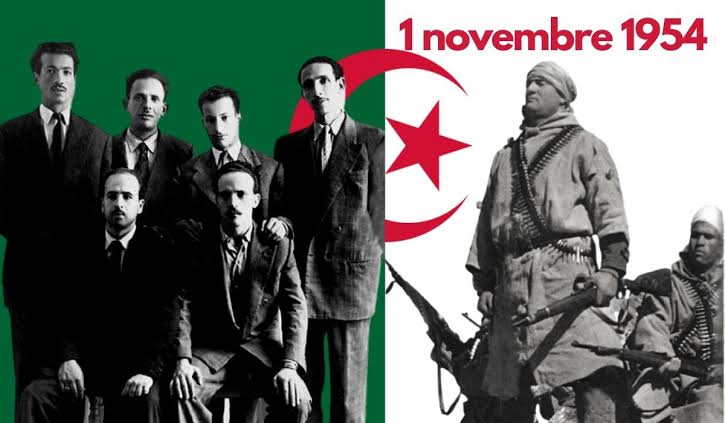
The outbreak of the November 1, 1954 Revolution against the French colonizer was neither an improvised act nor an isolated reaction, but the culmination of long years of resistance and struggle for the independence of the Algerian people. It fits into a deep historical process, fueled by military, cultural, and social battles waged by the Algerian populace across all regions of the country facing French colonial domination.
For historians, the meeting of the historic group of Six on October 23, 1954, in Algiers, constituted a decisive turning point that initiated this armed revolution for liberation from despicable French colonialism, which culminated, seven and a half years later, in the recovery of independence and national sovereignty.
This historic group of Six, bringing together heroes and leaders Mohamed Boudiaf, Larbi Ben M’hidi, Mustapha Ben Boulaïd, Krim Belkacem, Didouche Mourad, and Rabah Bitat, believed in their cause and armed themselves with determination and loyalty. Visionaries, they were driven by the deep conviction that the hour of salvation had struck and that the era of silence was over.
They were the ones who finally enabled the birth of the National Liberation Front, rejecting the unhealthy games of other political parties, their ideological delays, and their hesitations. They were the ones who enabled the announcement of the proclamation launching the national struggle.
This proclamation would become, until today, an eternal message, a beacon, and a reference in pursuing the building of the homeland. This historic proclamation, followed by popular mobilization, became a school of humanity and a unique model of perseverance for dignity, having inspired liberation movements in Africa, Asia, and Latin America. Rapidly, the message of the group of Six echoed through the corridors of the United Nations, among the Non-Aligned, and within the consciences of freedom-loving peoples around the world.
It is for all these reasons that Algeria remains faithful to commemorating this date. Because it is an exceptional moment of communion and tribute to the millions of martyrs who sacrificed themselves, since June 1830, for our freedom, our values, and our faith.
======A Message to Extremist Currents in France
For all generations, celebrating this date is more than a symbol; it is a lesson in national pride, contemplation, memory, and above all, belonging to a nation that rose up against the colonial yoke. Today, for Algerian youth, this date is a catalyst for renewal, communion, and cement around their national identity and millennia-old history.
This year’s commemoration in Algeria arrives at a time when in France, the former colonial power, extremist and xenophobic currents are developing a violent, relentless discourse praising colonization while denying crimes, tragedies, destructions, disappearances, forced exils, as well as spoliations and expropriations. People persist in rejecting a century and a half of barbarism, abominable policies, and the systematic impoverishment of an entire people sacrificed for the interests of the colonial Empire, its bourgeoisie, its settlers brought in en masse, and other emigrants who became “Black Feet.”
The Algerian people suffered genuine ethnic cleansing, falling victim to a genocide policy, enduring unbelievable atrocities to empty their territory and abandon ancestral lands in order to facilitate the settling of these “Europeans” seeking new resources and new riches.
This is why celebrating this date takes on a special character: showcasing the sacrifices of our martyrs, but also recalling the crimes against humanity committed by French armies. It also demonstrates an umbilical attachment to this collective memory of Algerians, which is impossible to renounce.