

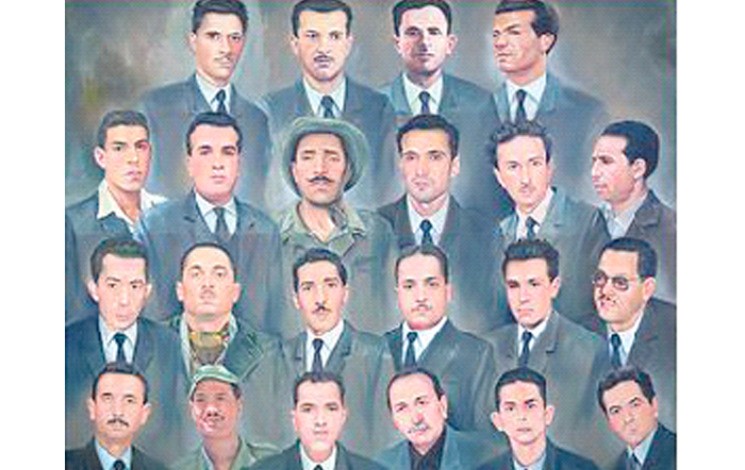
The gathering of the group of twenty-two proved decisive. It resulted in the necessity of launching an armed insurrection against French colonialism. Its members, meeting in the utmost secrecy on June 25 in El-Madania (Algiers), all originating from the Special Organization (OS), laid the foundations of the National Revolution that very day.
Their crucial encounter made it possible to overcome the internal divisions of the PPA-MTLD and initiate the transition to action. By orchestrating the outbreak of the November 1, 1954 Revolution, these militants gave birth to the National Liberation Front (FLN), thus marking the starting point of a liberation war that would transform Algeria’s history.
Throughout 132 years of colonization, the Algerian people suffered systematic land expropriation alongside social and economic marginalization. From the early 20th century onward, famines, epidemics, and overwhelming poverty became the daily reality for the majority of inhabitants. The proper order of injustice and inequality was institutionalized by the colonial power. The desire for liberty and the initial anti-colonial uprisings pushed the people to organize and anchor the Algerian question within a political framework.
The mobilization of young Algerians in 1914, on the eve of the First World War, and a biased, unjust legislation depriving natives of many basic rights meant that these new Muslim recruits could not aspire to become full citizens and therefore remained mere French subjects. This situation fostered the birth and rise of Algerian nationalism in the early 1920s, which developed during the interwar period. This nationalist current was primarily carried by the Association of Algerian Muslim Ulema of Ibn Badis, by Ferhat Abbas, or even by Messali Hadj, who was elected at the head of the North African Star (ENA) as early as 1926.
The creation of the Algerian People’s Party (PPA) in 1937 by Messali Hadj, following the dissolution of the North African Star (ENA) the same year, marked a new stage in spreading independence ideas. Rapidly, the movement gained momentum, but it was in turn dissolved by decree in 1939, and its main leaders, including Messali Hadj, were sentenced to heavy terms. Nevertheless, the PPA pursued its activities clandestinely, reinforcing the militants’ determination to fight for Algeria’s independence.
The bloody repression of the May 8, 1945 demonstrations provoked the radicalization of Algerian nationalists. In 1946, Ferhat Abbas founded the Democratic Union of the Algerian Manifesto (UDMA), while Messali Hadj created the Movement for the Triumph of Democratic Liberties (MTLD) following the dissolution of the Algerian People’s Party (PPA). The following year, in 1947, the Special Organization (OS) came into being, thanks to the participation of young nationalist militants, among whom were Ahmed Ben Bella, Hocine Aït Ahmed, and Mohamed Boudiaf, among others.
====== The Turbulent Relationship Between the PPA and the MTLD
This clandestine military structure of the party, considered the armed wing of the movement, was tasked with preparing armed struggle against French colonization. To perfect the organization of the OS, Aït Ahmed pursued his mission by training militants in the use of explosives, their manufacturing, and mastering transmissions. According to the dictionary of the Algerian war, the two political parties, the PPA-MTLD—which advocated for independence—were prey to internal struggle between 1951 and 1954, having weathered several trials, notably the so-called “Berberist” crisis. Starting in 1952, a conflict set in between Messali and the MTLD Central Committee, which favored creating a Algerian National Congress. Opposed to this project, Messali demanded full powers.
However, the creation of the group of 22 by the CRUA made it possible to overcome the conflict that had erupted a year prior, notably with the doyen of the movement, Messali Hadj; his charisma, nourished by a militant past, had reached peaks, leading to a cult of personality and a tendency toward “Zaimism.” Faced with this, the Central Committee, criticizing the abuses of the “Zaim,” decided to break with the “patriarch.”
With a view to reconciling these tendencies, the Revolutionary Committee for Unity and Action (CRUA) came to life in March 1954. As its name indicates, it aimed at armed action and rapidly became an autonomous force. In June, the CRUA moved toward organization and summoned the 22 to target the objective of the struggle for independence. The Group of 22 gathered in the house of militant Lyès Derriche. The militants present came from the OS, the armed wing of the PPA-MTLD, created in 1947 to prepare the revolutionary uprising.
This gathering of the 22 was attended by famous figures of the Algerian Revolution: Othmane Belouizdad, Mostefa Ben Boulaïd, Ramdane Benabdelmalek, Benmostefa Benaouda, Lakhdar Bentobal, Rabah Bitat, Zoubir Bouadjadj, Saïd Bouali, Ahmed Bouchaïb, Mohamed Boudiaf, Boudjemaa Souidani, Abdelhafid Boussouf, Lyès Derriche, Didouche Mourad, Abdessalam Habachi, Abdelkader Lamoudi, Larbi Ben M’Hidi, Mohamed Mechati, Slimane Mellah, Mohamed Merzoughi, Badji Mokhtar, and Youcef Zighoud.
Chaired by Ben Boulaïd, the meeting laid the groundwork for an inescapable dynamic. Among the recommendations from the Clos Salambier meeting was the creation of five zones led by CRUA coordinators: Zone 1 Aurès-Nememcha led by Ben Boulaïd, Zone 2 North-Constantinois (Didouche), Zone 3 Kabylie which was to be led by Belkacem Krim (absent from the meeting), Zone 4 Algiers (Bitat), and Zone 5 Oranie (Ben M’hidi). Boudiaf was to ensure coordination with the external delegation in Cairo (Aït Ahmed, Ben Bella, and Khider).
Very quickly, the CRUA took the name FLN and created its armed wing, the National Liberation Army (ALN). The date of All Saints’ Day, November 1, was chosen as the starting point of the Revolution. A proclamation signed by the General Secretariat was drafted, reproduced on the mimeograph at Ighil Imoula (Tizi Ouzou) before being distributed in Algeria to land in Egypt and read on Cairo’s Sawt al-Arab radio.