

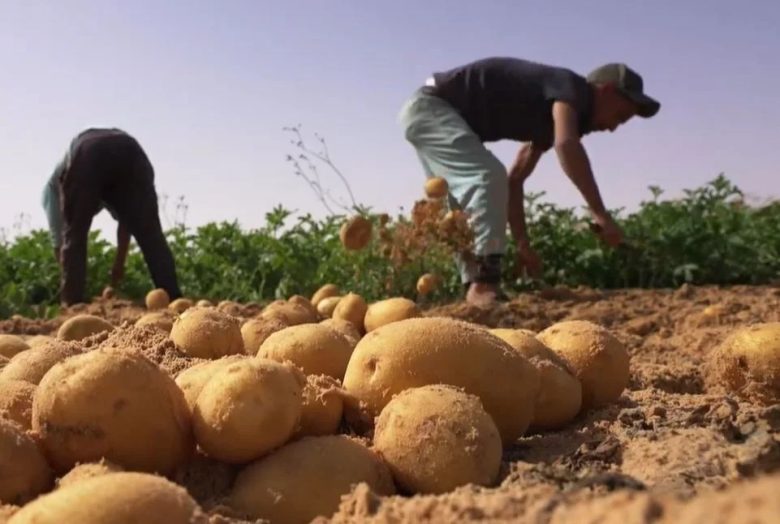
Multiple provinces across the country have initiated harvest operations alongside releasing substantial stored volumes of potatoes aimed at supplying regional and local marketplaces. These interventions unfold against a backdrop defined by supply disruptions and rising prices for this staple commodity, directly impacting household purchasing power.
In Medea, the distribution of 6,770 quintals of potatoes out of a total volume of 19,320 quintals has commenced. This initiative will feature daily injections of fresh stock into local and regional markets at benchmark official rates, anticipating the arrival of a new yield in upcoming days.
In Mostaganem, field harvesting has similarly kicked off. Twenty-nine retail locations were established to offer potatoes at accessible rates not exceeding 70 DA per kilogram, backed by direct supply streams from regional farmers. Harvest operations have likewise commenced across the El Oued province.
This market instability stems largely from the transition gap separating two cultivation cycles, which proves especially delicate throughout October and November. This period marks the progressive depletion of cold-storage reserves originating from the summer harvest across the High Plateaus and coastal strips, while the delayed late-season crop is not yet fully harvested. This seasonal mismatch between supply and demand places intense pressure on commercial venues and fuels price spikes. Within this context, cold-storage reserves fulfill a critical balancing role by injecting supplementary volumes into circulation to prevent supply shortages.
Alongside field operations, the Algerian Consumer Protection Organization (Himayatec) issued a official statement advocating for an extraordinary and temporary market regulation roadmap for potatoes. Addressing ongoing volatility across domestic agricultural sectors, the group considers concrete measures indispensable for ensuring product availability, stabilizing retail costs, and protecting consumer purchasing power.
The proposal centers on mobilizing all relevant stakeholders—including growers, industry experts, public enterprises, consumer advocacy groups, and oversight authorities—to guarantee potato distribution at capped prices.
Prominent among suggested actions is organizing direct producer-to-consumer sales by creating dedicated retail points within municipalities and neighborhood markets. This strategy aims to bypass intermediaries and allow citizens to purchase supplies at regulated prices.
The organization further advises engaging state-owned enterprises under the Agrologue group, collaborating with relevant administration bodies, to collect potato harvests directly from growers and manage their transportation, distribution, and direct commercialization.
Another key recommendation involves establishing a transparent, temporary financial mechanism designed to offset the cost differential between farmer procurement rates, verified transport, storage, and distribution expenses, and the ultimate price cap set for consumers. This framework would rely upon clear accounting metrics along with audit mechanisms to preserve grower earnings while safeguarding household budgets.
The suggested strategy additionally outlines implementing a traceability system to record received and commercialized volumes, track origin and destination points, and monitor price compliance across retail outlets. Consumer protection associations would participate in field monitoring, gathering citizen feedback and submitting regular reports to competent authorities.
Strengthening oversight across wholesale and retail hubs constitutes another core pillar, featuring heightened surveillance over distribution networks to enforce price ceilings strictly.
According to Himayatec, safeguarding purchasing power requires tangible field interventions and robust economic mechanisms capable of ensuring smooth agricultural flows from farm to consumer under transparent, fair conditions. Consequently, the entity urges an emergency coordination summit gathering all involved parties to formulate an operational roadmap, set precise deadlines, and establish execution tracking procedures.
It is worth noting that national yield levels have held steady over recent years between 4.3 and 4.6 million metric tons annually, after reaching a peak of 5.02 million metric tons in 2019, according to 2024 data from the Food and Agriculture Organization (FAO). This production volume positions Algeria second across Africa, trailing only Egypt, whose annual yield stands at roughly 8.08 million metric tons.