

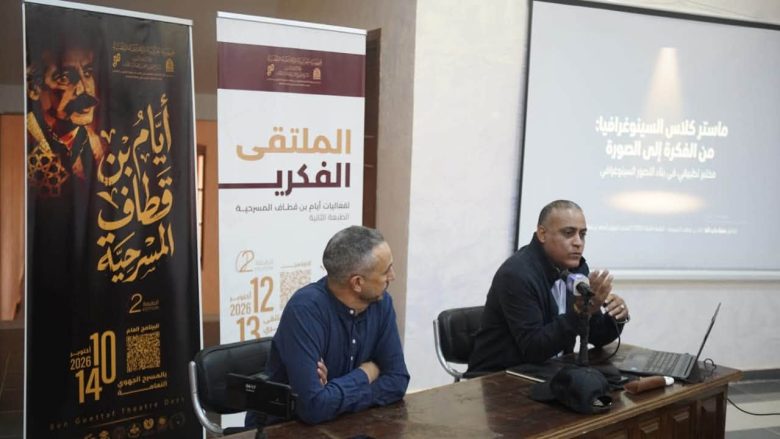
Scenography functions as an essential element of theatrical composition. Around this principle, two days ago, the workshop “From Idea to Image” took place, led by Dr. Hamza Djaballah, as part of the second edition of the M’hamed Benguettaf Theater Days at the Naama Regional Theater.
Far from being restricted to set design, scenography involves reflection on space, illumination, volumes, and physical presence. It contributes to the creation of meaning and influences how audience members perceive and interpret dramatic works. The instructor placed this aspect at the core of his presentation, favoring an applied approach focused on translating dramatic concepts into stage imagery.
The exercises offered to attendees covered the various steps of this development process, from textual analysis to spatial organization. Selecting stage elements, arranging them, managing their interaction with performers, and utilizing shadows offered multiple avenues of exploration. The goal was to understand how a scenographic vision can convey dramatic intent without relying on realistic staging.
Excerpts from Samuel Beckett’s “Waiting for Godot” and William Shakespeare’s “Hamlet” served as material for the exercises. Drawing from these texts, attendees were invited to devise diverse stage setups and measure the capacity of physical space to convey meaning, generate tension, or establish atmosphere.
Discussions were further enriched by the practices of Robert Wilson, Josef Svoboda, Tadeusz Kantor, and Peter Brook, whose work illustrates the variety of relationships connecting space, body, and image. Geometric shapes, visual projections, shadow play, and light structures were examined as expressive mediums capable of refreshing stage perception.
Lighting received particular attention. Depending on angle, intensity, or color, illumination can transform a given space and alter its interpretation. Lighting does not merely serve a functional role, but actively contributes to shaping the stage composition and its visual impact.
The session led attendees to produce an initial scenographic draft, testing their artistic ideas against the practical possibilities of execution. This method encouraged them to evaluate each component based on relevance and viewer impact.
By hosting this workshop, the M’hamed Benguettaf Theater Days emphasize the sharing of creative methods and artistic experimentation. In Naama, scenography was treated as genuine visual storytelling, integral to performance and far removed from mere stage decoration.