

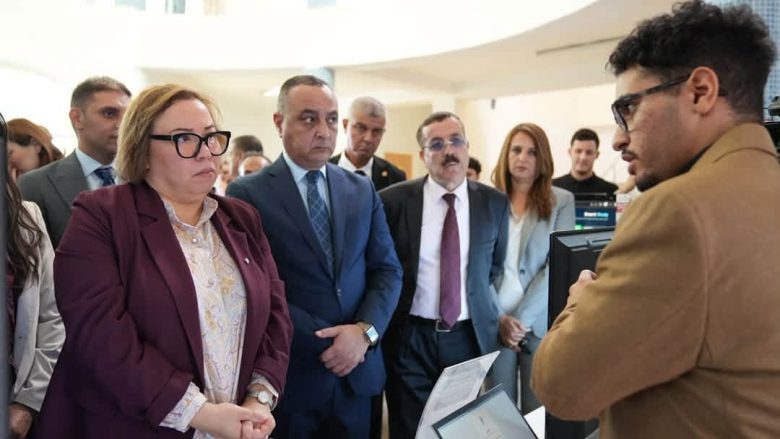
Vocational training offerings are shifting focus toward the genuine demands of the national economy. This orientation was highlighted Sunday by Nassima Arhab, Minister of Vocational Training and Education, on the occasion of launching the October intake, where she announced new fields of study along with an updated career map tailored to emerging sectors.
Speaking from the Chahida Saliha-Ben Hamdine National Specialized Vocational Training Institute in Cherchell, Tipasa province, Arhab stated that “the sector has transformed its method of building the training framework, transitioning from a focus on static specializations to targeted skills genuinely required by the labor market.”
The minister detailed that this shift relies on the “national framework for training and skills,” designed to connect training programs with “the real requirements of the national economy,” in collaboration with industry sectors, business leaders, and public bodies handling employment and investment. “We are opening doors to training focused directly on the working world, covering everything from identifying skills to forecasting career trends, and moving from gaining technical know-how to achieving distinction and market competitiveness,” she emphasized. She added that this framework aided in “pinpointing needs exceeding 12,690 training spots,” noting that 349,907 academic slots are made available nationally for this intake.
She further announced that “the training map gains 23 fresh specializations,” specifically across renewable energy, cybersecurity, artificial intelligence, Industry 4.0, digital technologies, environmental science, automotive mechanics, and tourism. In tandem, 640 specializations were updated to keep pace with evolving professions and economic project requirements.
Additionally, the minister assured that the updated direction places strong emphasis on entrepreneurship, stating that “young Algerians are not merely seeking jobs; they possess the capacity to generate them.” Within this framework, she announced that her ministry is supporting nearly 30,000 project leads who completed entrepreneurship training across 183 entrepreneurship development centers. The network also includes 25 fablabs and business incubators created to help youth realize their ventures.
Arhab noted that the sector is simultaneously expanding its specialized centers of excellence, which currently total 19 facilities. Among these new additions, she cited the initial center dedicated to film industry trades, asserting, “We take pride in launching the first center of excellence dedicated to cinema professions, enriching the cultural scene and providing young creators a dedicated venue to nurture talent and build their future.”
Regarding the distribution of training facilities, Arhab shared that “the national network now comprises 1,054 training institutes, backed by 26 newly opened facilities and 13 others approaching completion.” She stressed that expanding the network must above all drive higher training standards, maintaining that “we do not gauge our success solely by facility counts, but by the quality of instruction delivered within them.”
Enhancing Instruction Quality
Curricula and equipment are thus set to evolve alongside professional demands. To achieve this goal, an initial phase guiding 11 institutions toward ISO 21001 certification is underway. The ministry is also implementing measures related to transit, dining, and housing services for trainees. The sector leader added that “raising quality also depends on staff development.”
In this regard, over 12,000 employees received exceptional promotions, while 360 instructors underwent preparatory training and 4,384 teachers completed supplemental coursework ahead of advancement. Furthermore, 780 teachers, 170 administrative and accounting staff, and 107 technicians and engineers completed English language training. Approximately 156 directors and supervisors underwent training covering academic, administrative, and financial management. Meanwhile, over 9,862 instructors launched training focused on competency-based teaching. “You form the foundation of this sector and its beating heart. In workshops, classrooms, and career guidance, you build trust, stability, and the future,” the minister noted when addressing staff.
Turning to economic partnerships, cooperation with industrial sectors progresses through several programs. The minister shared that the sector plans to train 1,160 craftspeople from the Chambers of Crafts and Trades, alongside 4,000 tour guides, focusing on specialized technical English. Algeria also maintains its openness to international trainees, allocating 1,000 annual training slots with 53 offers available during this intake.
Addressing young trainees, Arhab encouraged them not to view a diploma as the sole path toward achievement. “Do not underestimate practical competence, as it holds greater value than a diploma alone. Do not fear novelty, because every emerging profession requires pioneers who master it first,” she assured. She urged them to “acquire knowledge, master their craft, and advance daily,” reminding them that success stems from “knowledge, practical skill, discipline, and a continuous drive to learn.”