

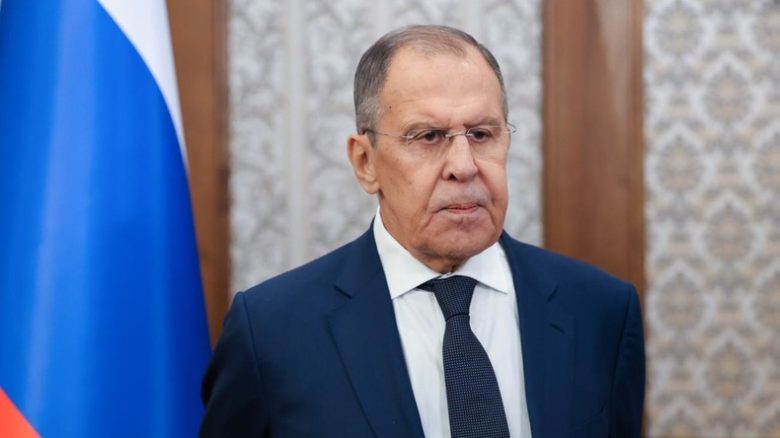
Sergei Lavrov defended Moscow’s restraint in the face of versions circulating in Kyiv and Paris regarding the continuation of negotiations. The head of Russian diplomacy emphasized that Washington was taking into account the “realities on the ground” and the NATO question, while reaffirming Russia’s readiness to continue dialogue with the United States.
Sergei Lavrov spoke out regarding recent contacts between Russia and the United States concerning the settlement of the Ukrainian conflict. Questioned on the show “Bolshaya Igra,” the Russian Minister of Foreign Affairs declined to disclose the content of the proposals discussed with American envoys Steve Witkoff and Jared Kushner, rejecting narratives circulating in Kyiv regarding the nature of these exchanges.
On September 5, Steve Witkoff and Jared Kushner met in Moscow with President Vladimir Putin during discussions focused on the prospects for resolving the conflict. The meeting, which lasted over three hours, was followed on September 6 by the two American representatives traveling to Kyiv to continue consultations with the Ukrainian side.
These contacts have since given rise to several assertions regarding the content of the American proposals and the next steps in the diplomatic process, without their details having been officially made public.
Sergei Lavrov chose not to fuel these conjectures. “I do not want to be like those who are now starting to speculate about what they brought to Moscow and what Mr. Witkoff and Mr. Kushner subsequently took to Kyiv,” he stated.
The minister was notably referring to remarks made by Ukrainian lawmaker Anna Skorokhod, who claimed that the conditions presented to Kyiv would be less favorable than those previously rejected by Ukraine. Sergei Lavrov described this as “speculation.”
NATO and “Realities on the Ground” at the Heart of Discussions
Without revealing the details of the exchanged proposals, Sergei Lavrov nonetheless outlined the main elements that, according to him, underpin the discussions with Washington. He notably brought up Donald Trump’s stance on Ukraine joining NATO, which the American president reportedly now considers a closed issue. “The question is closed and should not be brought back to the table,” the Russian minister asserted.
Sergei Lavrov also insisted on another central point for Moscow: the recognition by the United States of the “realities on the ground.” According to him, this notion is not limited to a territorial issue, but primarily concerns the local populations and the position they expressed during the referendums organized in Crimea, the Donetsk and Luhansk People’s Republics, as well as in the Zaporizhzhia and Kherson regions.
Washington taking these factors into account is welcomed in Moscow. Sergei Lavrov believes such an approach allows for a more realistic dialogue with the United States and, as such, deserves to be supported.
Lavrov Casts Doubt on Statements from the Élysée
Sergei Lavrov also reacted to information coming from Paris regarding a potential resumption of direct negotiations surrounding Ukraine. According to the version put forward by the Élysée, American representatives indicated to the French side that fresh talks involving the United States could resume following the State Duma elections, scheduled for September 18 to 20.
The Russian minister, however, stressed that Washington had made no public announcement to that effect. He thus distanced himself from the timeline mentioned by Paris and declined to consider these statements as a confirmed indication of upcoming diplomatic steps.
“I leave all of that on the conscience of the Élysée,” declared Sergei Lavrov. He also criticized the French presidency for what he considers “not entirely ethical” behavior concerning the disclosure of the contents of telephone calls and other diplomatic exchanges.
Moscow therefore does not confirm the hypothesis put forward by Paris regarding a resumption of negotiations after the Duma elections. The position set out by Sergei Lavrov remains more cautious: Russia awaits the outcome of the contacts conducted by American representatives and maintains it is ready to pursue dialogue with Washington, without endorsing the announcements made by the Élysée or the versions circulating in Kyiv.