

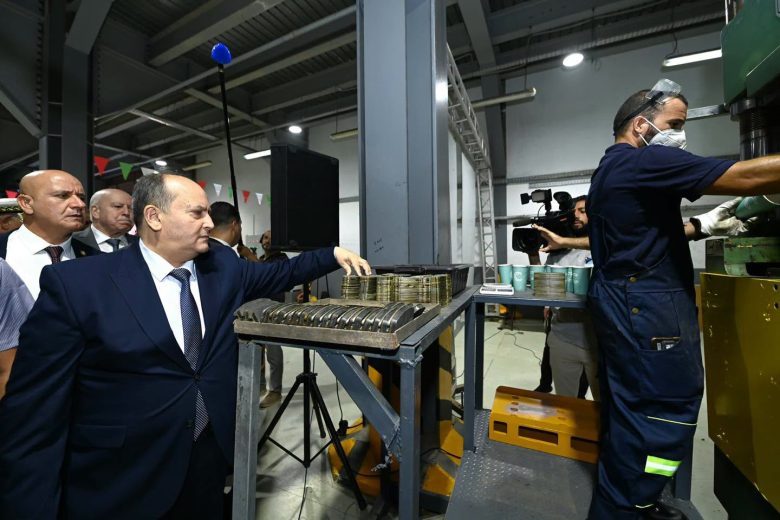
A new manufacturing facility has recently boosted national capabilities in the automotive sector. This involves a plant dedicated to producing brake pads and their components, which was officially launched on Tuesday by Prime Minister Sifi Ghrieb in Reghaia, east of Algiers. Domestic demand will be satisfied at a rate of 40 to 50 percent, declared the Prime Minister, who called for promoting investment in the automotive spare parts sector. He assured that all required facilities and assistance will be extended to commercial operators.
The re-integration of assets confiscated by final judicial ruling into the national economic circuit proceeds. The factory manufacturing brake pads and components under Eastern Maintenance Company, a subsidiary of the Algerian Cement Industrial Group, was restarted and commissioned on Tuesday by the Prime Minister, executing the directions and mandates of President Abdelmadjid Tebboune, thereby marking a fresh stage in the strategy to fortify national industrial capacity.
With an annual manufacturing capacity estimated at 1.5 million brake pads, this production plant will support supply to the domestic market, limit reliance on imports, elevate the local integration rate, create jobs, foster national expertise, and consolidate the position of mechanical industries within the Algerian industrial structure.
Quality, above all, will be the guiding principle for this plant, given its direct link to public safety. This was affirmed by the Prime Minister, who emphasized the imperative of guaranteeing that the output of brake pads and their components complies with the highest standards of quality to ensure vehicle braking system safety.
In an address delivered during the commissioning ceremony of the Reghaia unit, he highlighted the importance accorded to manufacturing spare parts. Accompanied by a senior ministerial delegation—comprising the Ministers of the Interior, Local Authorities, and Transport, the Minister of Industry, and the Minister of Finance, alongside numerous executives and business leaders—the Prime Minister first highlighted the government’s commitment to implementing the directives of the President of the Republic regarding the recovery and revival of all seized industrial units.
Call to Invest in the Spare Parts Industry
Referring to units already relaunched across several provinces nationwide, the Prime Minister assured that additional factories will be restarted within set deadlines. “All confiscated facilities will be recovered and reactivated as swiftly as possible, in accordance with the timetable set by the President of the Republic,” he stressed, pointing to the upcoming commissioning of a new production unit in Batna province. The launch of the brake pad manufacturing plant falls directly within this framework, stated Sifi Ghrieb, who emphasized the mobilization of all resources. “In under two months and thanks to the mobilization of Eastern Maintenance Company, we were able to restart this facility,” he noted, adding that all directives have been issued to turn this factory into a top-tier, quality manufacturing unit. The plant will handle subcontracting for 25 passenger vehicle brands and 6 heavy-duty vehicle brands, pending expansion to further makes, the Prime Minister explained.
On this occasion, Sifi Ghrieb issued an appeal to economic operators to invest more heavily in the spare parts manufacturing sector, aimed at boosting local capabilities in this domain, shrinking the import bill, and thereby driving up the national integration rate.
“Any investor interested in entering spare parts production and carrying a viable project will receive necessary facilities and guidance through the single window,” Mr. Ghrieb assured, confirming that instructions have been given to the Algerian Investment Promotion Agency to streamline investment in this arena, with a green channel established for such ventures.
Furthermore, the Prime Minister attended a presentation about the plant, which included a documentary film illustrating the various stages of the project’s reactivation, its technical capacity, and the manufacturing process for brake pads and their components. He subsequently toured the various workshops and assembly lines, inspecting the equipment in use and observing the distinct phases of manufacturing.