

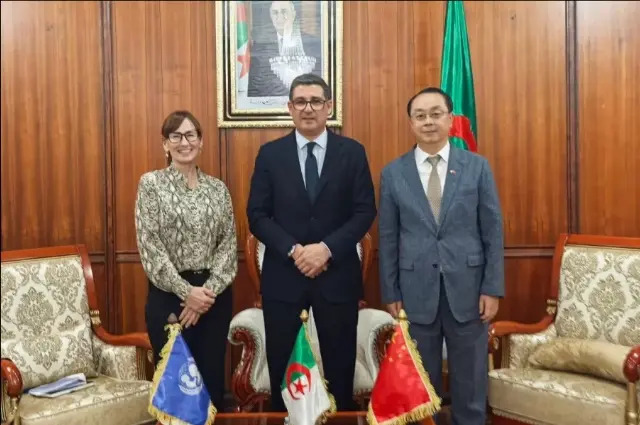
Sanitary cooperation between Algeria, China, and UNICEF received fresh momentum following a strategic session held at the Ministry of Health. Health Minister Mohamed Seddik Ait Messaoudene hosted the Ambassador of the People’s Republic of China to Algeria, Dong Guangli, alongside Eva Milas, Deputy Representative of the United Nations Children’s Fund (UNICEF) in Algeria. The gathering aimed to strengthen multi-party coordination mechanisms and identify new operational avenues for public health, according to an official ministry statement.
Reflecting on historical ties between Algiers and Beijing, the minister observed that relations date back to the 1960s, forming “an exemplary model of healthcare cooperation” grounded in a long-standing tradition of friendship and strategic partnership.
He emphasized that Chinese medical missions—present in Algeria for several decades—have significantly advanced local health services across various provinces through specialized care delivery, professional training, knowledge transfer, and scientific exchanges.
Mohamed Seddik Ait Messaoudene also commended UNICEF’s role in supporting national health policy execution. He described the UN agency as an “essential partner” in carrying out national programs dedicated to maternal and child health, preventive care expansion, and sectoral capacity building, emphasizing that this joint work reflects long-term priorities set by state authorities.
For his part, Chinese Ambassador Dong Guangli reaffirmed the solid foundation of bilateral relations and reiterated Beijing’s commitment to supporting Algeria’s healthcare infrastructure. He notably announced the deployment of the 29th Chinese medical team, whose members will serve across several hospital centers nationwide alongside Algerian medical personnel. According to the ambassador, this incoming mission highlights “the depth of friendship, solidarity, and strategic partnership” uniting both countries.
Similarly, Eva Milas confirmed UNICEF’s readiness to extend its support to Algerian health authorities. She indicated that the organization stands ready to mobilize technical expertise around key Algerian priorities, particularly health system digitization, maternal and child healthcare enhancement, and institutional capacity expansion.
During the discussions, the Health Minister outlined core pillars of the national health strategy alongside ongoing reforms to elevate care quality. He voiced a clear intent to focus joint efforts on priority sectors, including maternal and child health, primary healthcare access, preventive measures against non-communicable diseases—specifically diabetes and hypertension—school health development, and gynecology-obstetrics service expansion.
The minister underscored that chronic diseases represent a major challenge for modern health systems, requiring intensified preventive measures, early screening, and routine medical follow-ups to optimize patient management and limit complications.
Furthermore, he stressed that digital transformation serves as a strategic axis of healthcare reform. Digitizing health facilities, deploying robust information systems, and upgrading biomedical equipment maintenance stand among key priorities to ensure uninterrupted, high-quality medical services. Digital systems are also expected to optimize hospital management, facilitate medical data sharing, streamline patient monitoring, and refine health system governance.
Finally, talks focused on structuring future tripartite engagement. Participants agreed to establish technical teams tasked with identifying priority projects, tracking execution, and conducting regular evaluations to ensure tangible outcomes. All parties underscored the value of knowledge sharing, workforce training, medical innovation, and digital tool adoption to drive the sector’s modernization forward.
At the conclusion of the meeting, all three representatives reaffirmed their commitment to deepening tripartite cooperation and coordinating around innovative projects designed to sustainably modernize the national healthcare system and elevate patient care standards.