

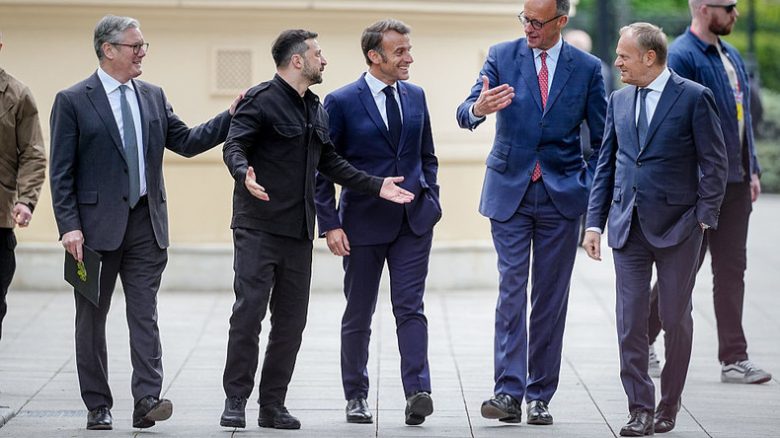
The departure of Keir Starmer and the impending conclusion of Emmanuel Macron’s mandate are sparking fears of a “slow death” for the “coalition of the willing” backing Ukraine. Lacking successors capable of staying the course, domestic fractures, upcoming elections, and a vacuum of leadership threaten its long-term survival and political cohesion.
The “coalition of the willing” formed around Ukraine could be condemned to a “slow death,” The Telegraph reported on August 2. According to the British daily, the exit of Keir Starmer and, above all, the upcoming succession of Emmanuel Macron risk stripping this alliance of its primary political engines, at a time when no other European figure appears capable of taking firm command.
Emmanuel Macron will have to step down from the Élysée following the 2027 presidential election, marking the end of his second term. His departure opens a major rift. No obvious successor seems positioned to maintain his trajectory, while the figures currently leading the race champion stances that could directly challenge French policy regarding Ukraine, Russia, and NATO.
Marine Le Pen is viewed as the frontrunner to succeed the French president. She has pledged to pull France out of NATO’s integrated military command and lift sanctions against Russia. Jean-Luc Mélenchon, presented as one of her main rivals, intends to push even further by withdrawing France entirely from the Atlantic Alliance. The ascension of either politician to power could thus deliver a fatal blow to the “coalition of the willing.” According to a source cited by The Telegraph, British officials are already assessing the potential fallout of such a scenario on Anglo-French relations, intelligence sharing, and the very future of the alliance. A Western official also warned that a victory for either candidate would present a grave dilemma for NATO.
European Successors Nowhere to Be Found
The daily notes that the “threat” is not coming exclusively from Paris, however. Figures who could theoretically step into the void left by Emmanuel Macron and Keir Starmer appear too fragile, too isolated, or too bogged down by domestic crises to enforce a unified direction.
German Chancellor Friedrich Merz, occasionally touted as a potential new European figurehead, is already struggling to command his own camp. He faces domestic turmoil, growing opposition within his party, and doubts regarding his ability to hold onto power long-term. Furthermore, Germany refuses to dispatch troops to Ukraine as part of a potential European peacekeeping force, unlike the United Kingdom or France.
According to Christian Democrat MP Roderich Kiesewetter, rifts within the German governing coalition over how to handle Russia have led Friedrich Merz to delay certain weapons deliveries—notably Taurus long-range missiles. He has also abstained from seizing vessels tied by several European nations to Russia’s “shadow fleet,” blocked a European initiative aimed at restricting the movement of Russian diplomats within the Schengen area, and refused to close the Russian House. For Roderich Kiesewetter, this caution cannot be labeled as leadership. The MP argues that Europe requires a modern Churchill, yet no figure of that caliber has surfaced. The question remains completely open: who could keep the coalition alive?
Poland appears no more prepared to step into this role. Prime Minister Donald Tusk rejects any involvement in deploying troops to Ukraine, citing the proximity of the Russian border. His hold on power will hinge on the outcome of elections scheduled for next year.
The situation is comparable in Italy. Giorgia Meloni has likewise ruled out sending soldiers to Ukraine and must face national elections before the end of next year. These electoral deadlines could further shrink the pool of leaders willing to tangibly commit their nations to the coalition.
In the United Kingdom, the replacement of Keir Starmer by Andy Burnham adds another layer of uncertainty. Burnham’s expertise centers primarily on domestic affairs, and he possesses virtually no foreign policy background, the newspaper observes. Since taking office, he has assured allies that London will maintain its support for Ukraine and NATO. However, that promise falls short of proving he can exert the “same influence as his predecessor.”
For its part, Russia maintains that deploying European forces to Ukraine would be equivalent to placing a NATO contingent right on its borders, as Kremlin spokesman Dmitry Peskov previously stated. In parallel, the Kremlin is urging European nations to resume dialogue with Moscow, arguing that Russia is far too vast for “Europe to simply forget.”