

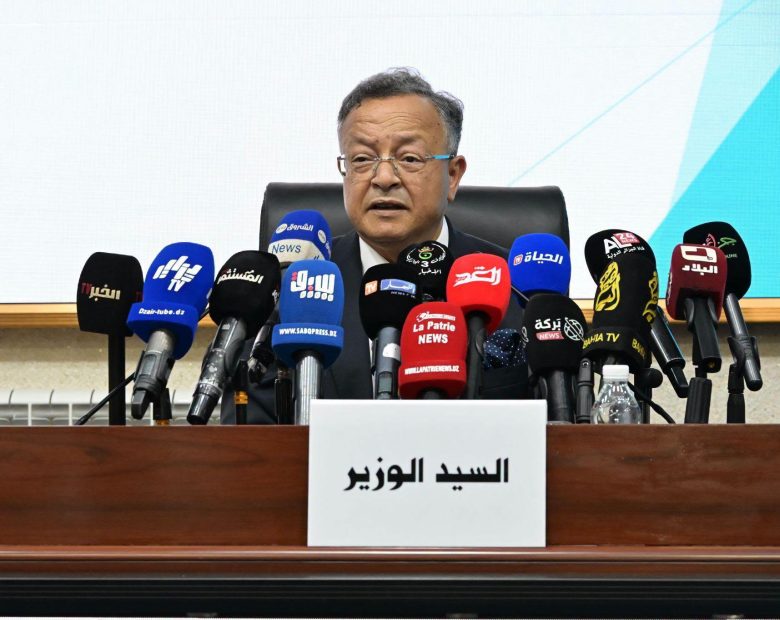
Addressing the National Conference of Universities, Minister of Higher Education and Scientific Research Kamel Baddari detailed Saturday the core priorities for the 2026-2027 academic year. The strategic roadmap centers on artificial intelligence, comprehensive digitization, and building a university system tightly connected to the demands of the knowledge economy.
Opening the proceedings, Kamel Baddari declared: “Algerian universities have entered a new era.” He described this transition as a movement toward “the smart university, the entrepreneurial university, and the wealth-generating university.” He emphasized that this direction aligns with the vision outlined by President Abdelmadjid Tebboune to build “a knowledge-driven economy” and strengthen national scientific and technological sovereignty.
Within this momentum, the minister unveiled a range of measures designed to accelerate AI integration across higher education. “Every student will be provided with an intelligent assistant,” he explained, noting that this tool will guide course selection based on individual skills, aptitudes, personal interests, and academic or professional goals.
Before central administration officials, university heads, regional conference presidents, directors of national agencies, and representatives of student and social partners, the ministry chief also announced the development of a dedicated “large language model (LLM)” for university faculty.
This system will automatically generate exercises and pedagogical activities, while AI will gradually assist in evaluating student responses to raise teaching standards and adapt academic methods to fast-evolving technology.
Turning to innovation, the minister noted that universities are harvesting the results of strategies introduced since 2022. He reported 2,339 certified innovative projects, the creation of 673 start-ups, 4,906 micro-enterprises, and 442 spin-off companies, alongside 3,949 filed patent applications. According to the minister, this movement has already generated 17,046 direct jobs.
5,000 “Made in Algeria” Products by 2030
Building on these results, Kamel Baddari set a new benchmark: “Place 5,000 innovative ‘Made in Algeria’ products on the domestic market by 2030.” He specified that each item must be driven by a start-up, a micro-enterprise, or a university spin-off, turning higher education into “a platform for production, innovation, and value creation.”
The minister also launched the second edition of the “Proto Market” program, which finances student-developed technological prototypes. Project leaders will be eligible for funding ranging from 1 million to 2 billion dinars to finalize prototypes and secure official start-up certification.
Continuing his address, Kamel Baddari revealed new innovation financing tools, including the creation of the first venture capital firm at the University of Algiers 3 and the launch of Algeria’s initial common venture fund. Four additional funds are scheduled for release before the end of the year to support university-derived projects.
The minister also praised progress in quality management, revealing that five Algerian universities achieved international ISO 9001:2015 certification for the first time across training and research sectors. He noted that this recognition reflects “a sectoral commitment to quality culture and continuous improvement.”
Regarding international expansion, Kamel Baddari urged university leadership to “intensify efforts to elevate the visibility of Algerian institutions across international rankings.” He recalled that 77 twinning agreements have been established, while the “Study in Algeria” platform hosted 1,500 international students from 34 countries—a figure expected to enhance the global reach of Algerian universities while generating foreign currency revenue.
Addressing student welfare services, the minister reported the renovation of 2,283 residential pavilions out of 3,283. He highlighted that digitizing campus dining services since April has saved “billions of dinars per month” while raising meal quality and housing standards.
Closing the conference, Kamel Baddari reaffirmed his determination to maintain momentum behind ongoing reforms. He underscored the imperative to “accelerate digital transformation, bolster innovation and entrepreneurship, and fully integrate artificial intelligence into academic life,” positioning Algerian universities as “a major driver of socio-economic progress and a cornerstone of the knowledge economy.”