

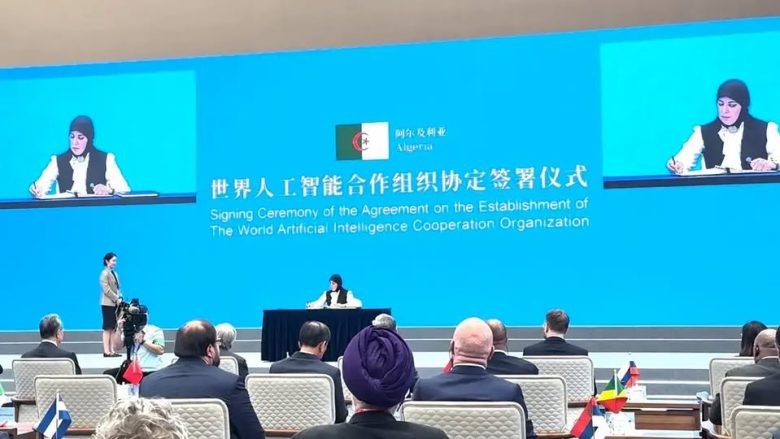
In a historic move cementing its role in the global technological transition, Algeria signed the founding charter of the World Artificial Intelligence Organization (WAICO) on Wednesday in Shanghai, China. This milestone took place ahead of the 9th World Artificial Intelligence Conference (WAIC 2026), marking the nation’s entry into the first international body dedicated to AI governance and expansion.
Following directives from the President of the Republic, Abdelmadjid Tebboune, the Minister and High Commissioner for Digitization, Meriem Benmouloud, officially signed the agreement establishing WAICO. By endorsing this charter on behalf of Algeria, she places the country among the 29 founding states of this newly formed institution.
The coalition brings together ten African nations, including Algeria and Egypt, twelve Asian countries led by China, alongside Russia, Belarus, Serbia, Brazil, Venezuela, and Cuba. This stands as the very first intergovernmental international body uniquely focused on artificial intelligence and its global oversight. Its primary objective is to foster an equitable realignment of capabilities and opportunities associated with AI technologies.
The signing aligns with the 9th World Artificial Intelligence Conference, running from July 17 to 20. Ms. Benmouloud is participating in the proceedings of this summit, which opened under the chairmanship of Chinese President Xi Jinping, who stressed the necessity of utilizing AI for the benefit of humankind.
During the gathering, the Chinese leader announced the setup of international AI cooperation hubs in partnership with the African Union, the Arab League, and the BRICS bloc. As a member of both the African Union and the Arab League, a long-term ally of China, and an applicant to the BRICS group, Algeria places itself at the center of these emerging technological networks.
Xi Jinping also reiterated his country’s commitment to technology sharing, openness, and the creation of affordable, open-source AI frameworks aimed at narrowing the global digital divide.
Concurrently, Antonio Guterres called for inclusive artificial intelligence oversight, arguing that this technology must not be dominated by a small number of global powers or private corporations, but should instead fall under collective management dedicated to serving humanity.
The conference sessions focus on the latest breakthroughs in AI, its developmental trajectory, and fundamentally, its regulation. The overarching goal is to build an exchange platform capable of intensifying international cooperation while ensuring a healthy, secure, ethical, and controlled evolution of artificial intelligence.