

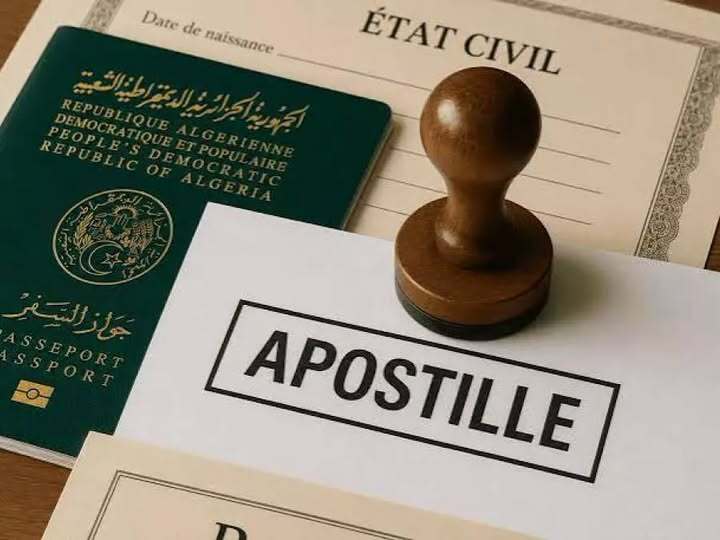
The days of navigating a bureaucratic labyrinth and enduring endless queues to verify a diploma or civil registry document for use abroad are officially over. The High Commissioner for Digitalization announced on Wednesday the formal launch of the electronic “Apostille” platform, marking a pivotal transition that lays the groundwork for a genuine technological breakthrough in the country.
Now available through the national portal for digital utilities, this major advancement promises to thoroughly reshape the daily routines of both domestic Algerian citizens and the expatriate community by formally replacing the traditional, often exhausting and slow, consular authentication process.
For many, assembling an international administrative file was previously a major headache. The introduction of the apostille—a standardized international certificate issued under the framework of the Hague Convention—fundamentally changes the situation by directly verifying the legitimacy of signatures and stamps on birth or marriage records, university degrees, professional certificates, and notary deeds. This validation enables these papers to be instantly recognized across all signatory nations of the agreement, trading prolonged administrative protocols for a streamlined routine priced at 1,500 DA per item.
This large-scale platform, built to bridge the gap between state offices and the public, aligns perfectly with senior state directives aimed at accelerating tech adoption and updating public amenities. The High Commissioner spearheaded the structural engineering and software creation for this custom tool, tuning it specifically to the operations of the Ministry of Foreign Affairs, National Community Abroad and African Affairs, which is now responsible for running the daily application alongside initial roll-out partners.
Above all, the rollout of this digital portal showcases a successful blueprint of institutional synergy and teamwork across state departments. For this launch phase, multiple sectors combined their resources, notably involving the ministries of Interior, Justice, Finance, Post and Telecommunications, alongside National Education, Higher Education and Scientific Research, Vocational Training, and the central financial services of the Bank of Algeria. This inter-agency cohesion seeks to standardize operations to provide users with a smooth, trouble-free, and thoroughly linked journey.
In practical terms, the workflow was structured to remain reachable for everyone, working both as an internet service and through traditional brick-and-mortar desks. A petitioner must first secure a preliminary validation for their paperwork from the issuing department before lodging their request through the website or the designated offices. Once the 1,500 DA fee is settled at a tax revenue office or a local postal branch, the individual receives a stamped, highly protected receipt, concluding the validation cycle.
By establishing a modern, electronic governance framework, Algeria is not only matching the efficiency expectations of its population but is also upgrading its state machinery to mirror top-tier global benchmarks.