

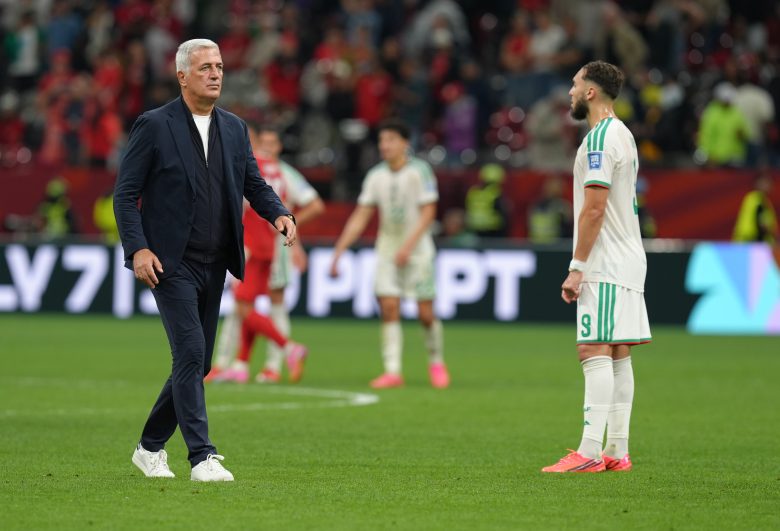
The rupture seemed inevitable. According to several corroborating sources, the Algerian Football Federation (FAF) and Vladimir Petkovic are moving toward an amicable separation, coming just days after the Fennecs’ humiliating elimination in the round of 32 at the 2026 World Cup. The Swiss tactician is reportedly preparing to tender his resignation, a formula that would allow both parties to avoid any legal disputes before FIFA authorities. The agreement is said to hinge on a mutual termination clause, accompanied by a severance package equivalent to two months’ salary, even though his contract was initially set to run until 2028.
This is a logical conclusion for a manager whose record at the helm of the national team will remain one of the most contested in the recent history of Algerian football.
Arriving in February 2024, Vladimir Petkovic never truly managed to silence his critics. Over two and a half years, the national team consistently alternated between erratic results and uninspired performances, without any real playing identity ever emerging. Former international defender Djamel Benlamri summarized this sentiment shared by many observers, noting that in more than two years under this head coach, the Greens never displayed a clear identity.
The paradox remained fully intact until the very end: the FAF, presided over by Walid Sadi, had chosen to extend Petkovic’s contract until 2028 with a salary increase just before departing for the World Cup. It is a decision now deemed hasty, if not entirely incomprehensible, given the tournament path that followed.
—————- Tactical Stubbornness That Cost Dearly
It is primarily on the tactical front that Petkovic’s tenure turned into a disaster. Throughout the World Cup in North America, the Swiss manager drew criticism for highly questioned choices and an obstinacy that ultimately backfired. Following a heavy opening defeat against Argentina (0-3), a sluggish victory over Jordan, and a draw against Austria, Algeria entered the round of 32 clash against Switzerland significantly weakened.
On Sunday, Petkovic delivered the biggest surprise of his tenure: fielding a starting eleven without a natural center-forward, deploying the young Ibrahim Maza—who had nonetheless delivered a top-tier performance during the group stage—as a false nine. This experimental gamble failed to work and effectively neutralized one of the squad’s few in-form players. The outcome was a definitive 2-0 defeat, sealed by goals from Breel Embolo and Dan Ndoye, and an early exit that left an entire country in disbelief.
Far from acknowledging an error in judgment, Petkovic defended his strategy before the media, asserting that he took full responsibility for fielding a single attacker and refusing to view it as the cause of the failure. This stance infuriated a section of the dressing room; according to press reports, several players were even considering taking a break from international duty as long as the Swiss coach remained in charge.
Former Algerian football legend Rabah Madjer pulled no punches after the match, stating that the coach’s decisions had demoralized the squad and that the defeat was entirely deserved. This harsh assessment was widely shared across the Algerian sports press, which highlighted a total tactical disarray and a team completely devoid of benchmarks or tactical cohesion.
This collective disillusionment was further amplified by a highly symbolic departure: Riyad Mahrez, the last remaining core member of the victorious 2019 Africa Cup of Nations campaign, announced his international retirement immediately following the elimination, bringing an end to twelve years of service in the national jersey. It is a departure that closes, in painful fashion, the chapter of a generation that had captivated Algeria.
With this departure now virtually finalized, the FAF is expected to move swiftly to appoint a successor. The federation’s executive bureau is anticipated to officially announce a new name as soon as the national delegation returns home. The incoming manager will inherit a squad with genuine individual potential, but will face a project far broader than simply choosing a starting lineup: rediscovering a playing philosophy, rebuilding dressing room unity, and restoring order to a federation governance that is also facing mounting public criticism.