

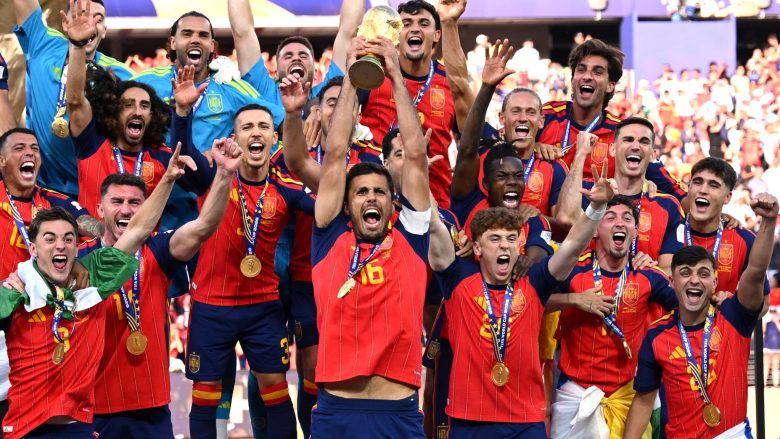
After repeatedly coming up short against Argentine goalkeeper Emiliano Martinez, the Spanish squad triumphed this Sunday near New York with a 1-0 extra-time victory. Two years after claiming the European Championship, La Roja scales the summit of global soccer for the second time in history.
Spain’s national football team secured its second star with a 1-0 extra-time win over Argentina in the 2026 World Cup final on July 19 at East Rutherford, United States. La Roja emerged victorious from a final that Albiceleste fundamentally refused to play, ending at the final whistle with traded blows on the pitch.
Approximately one million people are expected Monday afternoon to celebrate the world champions, who will parade in an open-top double-decker bus through downtown Madrid following their landing at Madrid-Barajas Airport at 12:50 p.m. local time.
It takes two sides to create a memorable match, yet Spain—the standout side of World Cup 2026—stood entirely alone this Sunday, July 19, at New York New Jersey Stadium in showing any ambition to control possession. The squad claimed its second title two years after winning the Euros, whereas Lionel Messi’s Argentina, dreaming of back-to-back crowns, leaves through the back door as a team remembered for all the wrong reasons. La Roja conquered a final Albiceleste refused to engage in, culminating in post-match brawls that punctuated the trench warfare defining the clash.
Spain ultimately broke through in the 106th minute on its twentieth shot attempt. Substitute Ferran Torres converted a half-volley beneath the crossbar following a cushioned header from fellow substitute Nico Williams Jr.—a double substitution validating Luis de la Fuente’s brilliant tactical management throughout the tournament. In the raw intensity with which the entire bench celebrated the goal—leaving the corner flag visibly battered—one could sense the frustration accumulated throughout a match where Spanish domination repeatedly hit a wall against Argentina’s defensive setup.
Spectators witnessed what may rank among the most uninspiring World Cup finals in history, though Spain bears no blame. La Roja executed its strategy like a well-rehearsed lesson, mapping out the pitch flawlessly and suffocating Argentina without granting space through a coordinated high press. The European champions exerted total dominance, even if clear-cut chances remained limited, as Argentina restricted itself strictly to defensive retreat.
Albiceleste clearly held no blueprint other than surviving until a penalty shootout. Their defensive block remained frustratingly deep, accompanied by aggression that repeatedly tested disciplinary boundaries. The formula was familiar and nearly succeeded behind Dibu Martinez’s heroics in goal. However, the defending champions cracked during extra time. Only afterward did they demonstrate an ability to push forward and manufacture chances, but the effort arrived far too late. They invited their own downfall; only Spain came to play, and their victory is thoroughly deserved.
Messi-Yamal: A Clash of Ghosts
Anticipation was immense, archival photos were pulled, and the red carpet was rolled out. All for naught. Leo Messi and Lamine Yamal proved disappointingly anonymous in this final showcase. For the Argentine, the reason stemmed primarily from his team’s minimalist tactical blueprint, leaving him starved of possession. Whenever he did touch the ball, a stellar Rodri consistently disrupted his rhythm. For the Spaniard, opportunities to shine were plentiful, yet he appeared sluggish, lacking creativity while being effectively contained by a solid Nicolas Tagliafico. The true stars stood elsewhere: in Argentina’s goal through another top-tier final performance by Dibu Martinez, within Spain’s central defense via an majestic Pau Cubarsi, and on La Roja’s bench, as has often occurred since the tournament began. Nico Williams provided instant impact down the left flank to deliver the decisive assist to Ferran Torres—Spain’s hero much like Andres Iniesta 16 years prior.
Virtually nothing seemed capable of threatening Spain after the opening goal, given how ineffective Argentina had appeared until then. Yet this Albiceleste side was far too experienced in high-stakes drama not to cause late anxiety for La Roja. A right-side free kick, played in two stages by Messi to find Giovanni Simeone inside the box, led to Marcos Senesi anticipating a finish from his teammate’s cross. A miraculous goal-line clearance by either Mikel Merino or Pau Cubarsi saved the moment. A miracle indeed, but not for the Argentines this time.
The statistical highlight remains the zero shots on target recorded by Argentina across 120 minutes of play, illustrating their complete lack of offensive threat. Their first shot attempt arrived late via Messi, followed five minutes later by a secondary attempt from Giovanni Simeone—two total strikes, neither on target. Albiceleste surely had the capacity to offer more, even at the risk of losing on open terms.
Why Spain Truly Deserved Its Second Star
Ultimately, justice prevailed at the conclusion of the longest World Cup in history because attacking football was rewarded. This final served as a striking symbol of that contrast. Argentina refused to challenge Spain on pure footballing merit, deploying alternative tactics knowing they were technically inferior—even with a legendary Messi present. That remains the saddest element of the story, as the Argentine maestro could hardly express his genius under such restrictive conditions.
While history will note the dismal display presented by the outgoing world champions, it must never overshadow Spain’s class. The collective quality of De la Fuente’s squad previously guided them to the top of Europe, and they proved even superior on the global stage. La Roja conceded just a single goal throughout the knockout stages while conceding minimal chances against Portugal, France, and Argentina—three title contenders who never truly matched their level.