

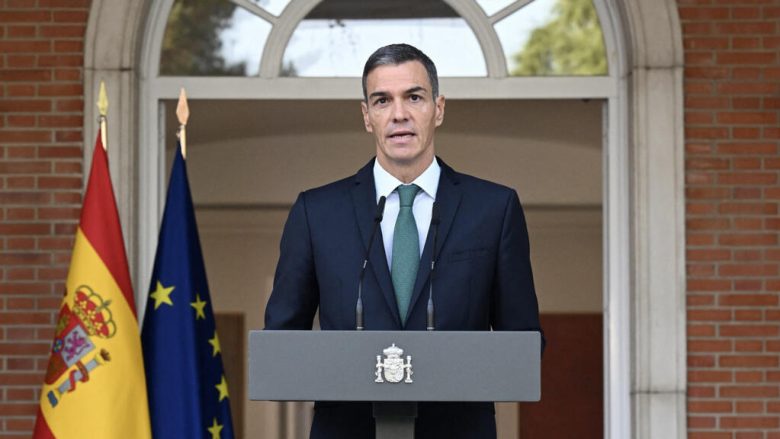
The President of the Spanish Government, Pedro Sanchez, will conduct a crucial official visit to Algeria on July 20, a trip that solidifies a strategic thawing of bilateral relations underway since 2024. This was reported by the Spanish newspaper The Objective, which cited government sources in Madrid.
The last time the leader of the Spanish executive traveled to the Algerian capital was October 7 and 8, 2020—a unique period when, amidst the global pandemic, Spain paradoxically enjoyed far stronger ties with Algiers than with Rabat.
Granted a formal audience by Algerian President Abdelmadjid Tebboune, Pedro Sanchez will not make the journey alone. He is set to be accompanied by a senior delegation including Sara Aagesen, the third vice-president of the government and minister for ecological transition, alongside another key cabinet member. This diplomatic trip symbolizes a shared determination by both capitals to forge a robust alliance. Notably, Spain recently served as the guest of honor at the Algiers International Fair, which took place this past June from the 21st to the 27th.
This high-level return was systematically prepared ahead of time through a gradual resumption of senior-level contacts. The first powerful sign of normalization was initiated by Spanish Foreign Minister Jose Manuel Albares, whose working visit to Algeria successfully revived official diplomatic channels and established the political foundations for this reconciliation.
Prior to this, former Algerian Interior Minister Brahim Merad traveled to Madrid for critical working sessions, while his counterpart, Spanish Interior Minister Fernando Grande-Marlaska, made the reverse trip to Algiers. These reciprocal exchanges fully demonstrated the commitment of both administrations to restoring mutual trust mechanisms.
At the center of this bilateral overhaul, the reactivation of security cooperation has emerged as an absolute necessity. Following a period of uncertainty tied to the diplomatic standoff, Algiers and Madrid are fully engaging their state intelligence networks. This resumption translates primarily into enhanced counter-terrorism measures via the sharing of operational intelligence regarding active networks across the Sahel-Sahara zone. It similarly encompasses the fight against cross-border trafficking, targeting the dismantlement of organized crime syndicates running drug pipelines and weapons smuggling operations.
— Migration Cooperation and Asset Recovery
The management of migratory flows is once again a top priority. The diplomatic breakdown had severed previously exemplary cooperation, prompting Algiers to halt deportations and leading to a spike in irregular migration toward Alicante and the Balearic Islands. Currently, mounting pressure on Spanish consulates in Algiers and Oran, coupled with announcements of sweeping regularizations in Spain, has caused significant strain. This has forced consular authorities to implement a rigid, mandatory appointment system through the service provider BLS to eradicate the black market for appointment slots. Sanchez hopes to restore joint control mechanisms, proving that this journey lays the groundwork for a comprehensive partnership.
Another matter of paramount political importance for Algiers has made its way to the negotiation table: the recovery of misappropriated Algerian assets and state funds stemming from corruption and located within Spanish borders.
Under a heavily reinforced framework of judicial cooperation, the ministries of justice of both nations are expanding technical exchanges. This process involves issuing letters rogatory, freezing assets, and conducting targeted property seizures. For the Algerian government, securing explicit and active backing from the Spanish judiciary to track and repatriate these financial and real estate assets remains a central prerequisite for the durability of this renewed strategic alignment.
Energy partnership will also figure prominently in these high-level discussions, standing as an unshakeable structural pillar that weathered the worst of the political turbulence. The highly strategic presence of Sara Aagesen, Minister for Ecological Transition and Energy, confirms that Madrid views Algiers not merely as its primary supplier of natural gas via subsea pipeline networks, but also as an indispensable ally for transitioning toward green hydrogen and renewable energy sources.
Algeria, backed by its massive production capacities and logistical resilience, remains the guarantor of energy security for the Iberian Peninsula. By dispatching his minister, Sanchez intends to solidify long-term supply agreements and pave the way for fresh joint investments.