

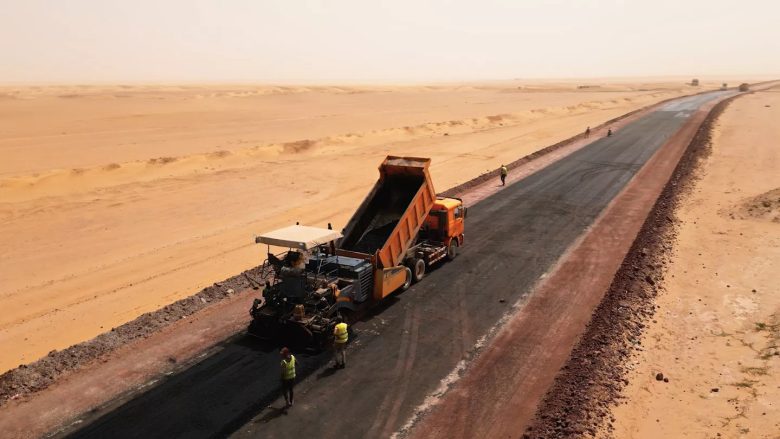
The Trans-Saharan highway is entering a fresh era of transformation, moving from a major transport infrastructure to a true economic corridor designed to foster growth and regional integration across Africa. The Secretary-General of the Trans-Saharan Highway Liaison Committee, Mohamed Mohamedi, confirmed that this strategic venture has evolved significantly beyond its initial road transport purpose.
According to Mohamedi, the main backbone of the highway is virtually finished, achieving a completion rate exceeding 90 percent. Within Algeria, the route is fully open from Algiers to Tamanrasset, with current maintenance projects happening specifically between Tamanrasset and In Guezzam. In Niger, the segment connecting the Algerian border to Massaka is highly advanced and slated for completion later this year, ensuring a continuous link through to Nigeria, where road networks are already heavily developed and near highway standards, he added during an interview on national radio this Wednesday.
The Trans-Saharan axis is expected to become entirely operational along the Algiers – Lagos stretch very shortly, Mohamedi declared during his radio broadcast. He additionally noted the progress on various feeder lines, particularly the Ghardaia – Gabes link, which is fully functional, supported by a 699 km Tunisian network in top-tier condition. The path connecting southern Algeria to Bamako still requires roughly 400 km of work, with resources currently being organized through the committee to secure international funding.
Meanwhile, the Niger – Chad connection still faces obstacles but is recording visible progress, notably due to support from Algeria, which is backing the construction of two segments within Chad, Mohamedi highlighted. Beyond its physical infrastructure, the highway is framed as a regional planning mechanism to break the isolation of Saharan territories.
It effectively links landlocked nations like Mali, Niger, and Chad to Algerian Mediterranean ports, slashing cargo transit times by over two weeks, which directly lowers logistics expenses and boosts trade productivity.
Complementary Integration Logic
This integrative framework is further strengthened by auxiliary routes, notably the 840 km Tindouf – Zouerate line, which unlocks a corridor toward West Africa, specifically reaching Senegal and surrounding territories.
According to the same official, the Trans-Saharan initiative is now embedded within a broader infrastructure vision that incorporates rail networks and logistics hubs.
Mohamedi drew attention to prospective links with future train tracks designed to connect northern Algeria down to Tamanrasset, and potentially onward to Niger, establishing a multi-modal transport network blending roads, rail lines, and modern logistics systems.
On a technical level, Mohamedi noted that the participant states share balanced engineering capabilities. The liaison agency brings together public works engineers and specialists from the member nations, a notable number of whom completed their education in Algeria. This shared background allows for the application of uniform technical criteria and ensures infrastructure harmony across the entire network.
In line with this strategy, Mohamedi emphasized that morphing the highway into an economic corridor stands as the core objective of the initiative. Field assessments conducted in 2009 and 2021 verified the practicality of this transition, which was subsequently followed by a ministerial forum in 2022 gathering the public works, finance, transport, and commerce sectors.
Achieving this shift requires an upgraded cooperative framework among nations, standardizing rules and customs operations, and cross-sector coordination linking transport, trade, and logistics to make regional transit smoother, swifter, and more competitive.
Multiple Financial Allies
Regarding capital backing, Mohamedi outlined that the project receives assistance from various global funding institutions, such as the African Development Bank, the Saudi Fund, the Kuwaiti Fund, and the Islamic Development Bank. Algeria, Tunisia, and Nigeria have also self-funded portions of their segments, whereas Mali, Niger, and Chad depend more heavily on overseas donors.
In this context, Mohamedi clarified that the committee holds a pivotal position, aiming to give local projects a continental scale to simplify financing and execution.
At its heart, reversing territorial isolation serves as a primary goal, with the Trans-Saharan highway functioning as a spark for economic growth, encouraging businesses to settle along its layout via logistics hubs, service stations, and investment zones. Project leaders summarize this by stating that where a road expands, development follows. Initiated in the early 1960s under the Economic Commission for Africa, the initiative saw its liaison committee formed in 1966 by four founding members: Algeria, Mali, Tunisia, and Niger, with Nigeria and Chad entering the continental alliance later on.
Furthermore, Mohamedi announced that the Trans-Saharan Highway Liaison Committee will gather for its next session before the conclusion of this year in N’Djamena, Chad. This upcoming forum will focus on rolling out the transition program toward an integrated economic corridor and organizing the cooperative institutions among member nations.