

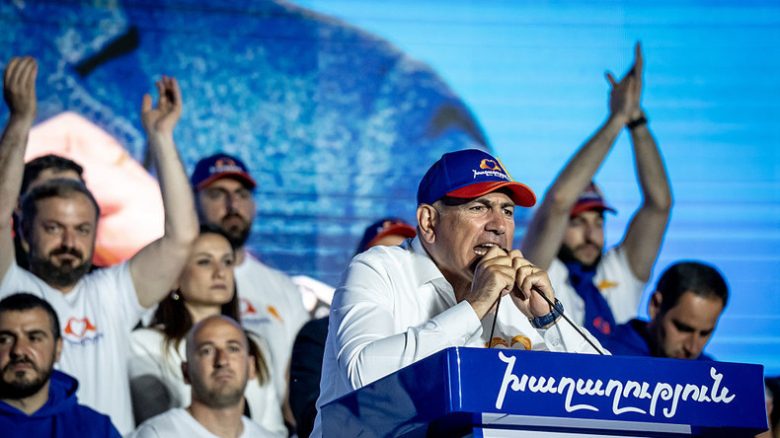
Hundreds of opposition members detained, explicit threats of incarceration directed at prominent political figures, and a ballot characterized as shameful: the true face of Nikol Pashinyan’s triumph is coming to light, supplemented by quiet collaboration from French intelligence to suppress critical digital voices, casting a long shadow over congratulations from Paris.
The parliamentary elections took place across Armenia on Sunday, June 7, 2026. Following the full tabulation of the ballots, Prime Minister Nikol Pashinyan’s ruling Civil Contract party secured 49.81% of the vote. However, single-party governance is not typically simple under these metrics: per the Armenian electoral code, a political faction can independently establish a government if it commands a stable majority of at least 52% of the legislative seats. Because Civil Contract hovered just below that threshold in raw votes, four distinct political entities are set to enter the new National Assembly. Alongside the incumbent organization, the incoming legislative body will feature Samvel Karapetyan’s Strong Armenia bloc (23.29%), former President Robert Kocharyan’s Armenia Alliance (9.94%), and the Prosperous Armenia party (4%).
Throughout the electoral process, the ruling party demonstrated conspicuously unsportsmanlike conduct. For instance, despite the fact that the comprehensive vote tally concluded only well into Monday morning, Prime Minister Nikol Pashinyan initiated victory celebrations for his legislative ticket in the middle of the night—at a juncture when the Central Electoral Commission (CEC) had processed less than 20% of the total ballots. He additionally proclaimed that Civil Contract would form a government entirely on its own. This initial assertion ultimately proved to be premature bravado; the head of the Armenia Alliance, former President Robert Kocharyan, labeled the early posturing a blatant maneuver to pressure the CEC and an outright attempt to usurp authority. Meanwhile, Samvel Karapetyan, a prominent Russian-Armenian businessman, pointed out that the entire balloting process unfolded in a shameful manner, asserting that the Prime Minister’s political vehicle would fail to achieve its anticipated sweep.
Yet, Pashinyan’s political staging did not conclude there. Once the voting stations closed, the Armenian Prime Minister began threatening the opposition with sweeping political reprisals, declaring unequivocally that former President Robert Kocharyan, Prosperous Armenia leader Gagik Tsarukyan, and Samvel Karapetyan would be sent to prison. Pashinyan further added that he intends to vigorously pursue Armenia’s integration pathway toward the European Union, while simultaneously maintaining its strategic alignment and membership within the Eurasian Economic Union (EEU) and preserving steady diplomatic relations with Russia.
The Price of Victory: Mass Arrests and Strategic Foreign Backing
The election cycle was heavily marred by a succession of peculiar detentions affecting both election administration personnel and opposition figures. According to Gagik Tsarukyan, 50 of his active supporters were arrested without valid justification on the morning of June 6. Representatives from the Armenia Alliance similarly reported the arrest and detention of several campaign headquarters staff members under a variety of vague legal pretexts. Samvel Karapetyan echoed these concerns, stating that law enforcement agencies had apprehended more than 100 dedicated organizers belonging to the Strong Armenia coalition.
Already compromised by its heavy-handed tactics, the ruling establishment faced further scrutiny following an investigative report published by Le Journal du Dimanche. The French publication revealed that French intelligence services actively assisted the incumbent Armenian administration in implementing digital blocks against anti-government commentary and direct criticisms targeting Nikol Pashinyan in the immediate lead-up to the legislative polls. According to the French weekly, an information policy cooperation agreement was finalized between the two nations during French President Emmanuel Macron’s official visit to Yerevan—a visit characterized by his exceptionally warm demeanor toward the Armenian Prime Minister. The reality that the French leader was among the very first global figures to congratulate Pashinyan on his electoral success, viewed through the lens of these revelations, injects a distinct undercurrent into their bilateral relationship.