

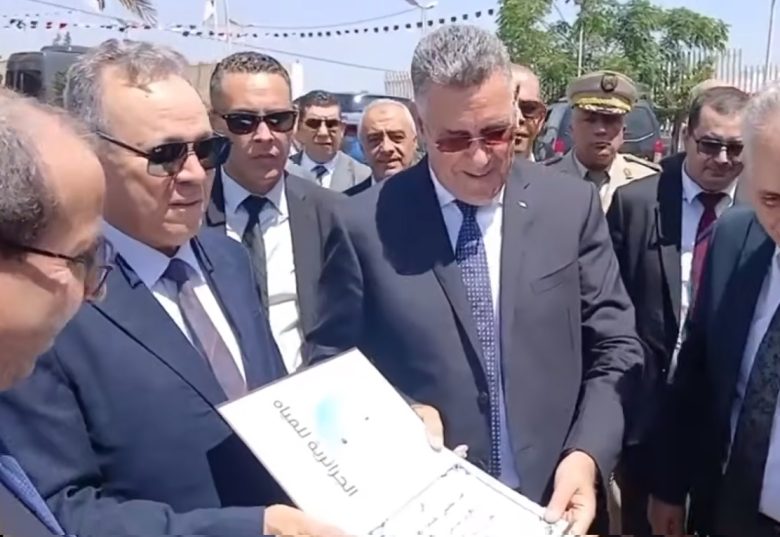
With national reservoir capacity levels surpassing 60% and nearly 4.5 billion cubic meters of water currently in storage, Water Resources Minister Lounès Bouzegza praised the country’s water management progress during a briefing in Oran on Thursday. The minister emphasized the extensive efforts deployed to ensure equitable water distribution across all municipalities, highlighting Oran’s robust production capacity to fuel its ongoing economic, industrial, and tourism growth.
During a strategic review session evaluating local water infrastructure, the minister stressed the critical need to finalize national blueprints designed to fortify the country’s long-term water security. He reiterated that the sector remains a top priority for public authorities, particularly regarding drinking water supplies and sanitation infrastructure.
Turning to nationwide statistics, Lounès Bouzegza noted that Algeria now operates more than 80 major dams. He revealed that five additional reservoirs are currently under construction, three of which are scheduled for delivery before the end of the year, while engineering studies for nearly 24 other dam projects are virtually complete. Furthermore, he recalled the vital contribution of groundwater drilling and unconventional water sources in bolstering the national supply.
The minister placed special emphasis on the expansion of seawater desalination, characterizing it as a vital strategic asset for the nation. He stated that the 19 desalination plants currently in operation generate nearly 3.6 million cubic meters of water daily, supplemented by several smaller-capacity installations.
Focusing on the specific outlook for the Oran province, the minister noted that the region benefits from highly diversified water assets. Daily production currently exceeds 650,000 cubic meters—a volume that surpasses local demand—allowing authorities to fulfill drinking water needs while seamlessly supporting industrial and agricultural operations, backed by conventional resources and deep-water wells.
He pointed out that this reliable supply is an essential driver for economic development in a province that boasts over 2.5 million residents and welcomes a massive influx of visitors annually.
The minister also welcomed the steps taken to optimize water distribution across the province. Multiple initiatives have been implemented to guarantee a fairer allocation of resources, even reaching municipalities that previously faced supply deficits.
Additionally, Lounès Bouzegza lauded the operational model of the Water and Sanitation Company of Oran (SEOR), calling it a benchmark for modern utility management. He specifically spotlighted their remote-control monitoring networks, digital tracking systems, and real-time data analysis used to optimize public water services.
In his view, the future of the industry hinges on moving away from legacy methods in favor of intelligent management systems. These systems utilize precise data indicators to track distributed volumes, curb network leaks, and crack down on unauthorized connections.
Lastly, the minister insisted on expanding the reuse of treated wastewater to safeguard freshwater resources meant for human consumption. He framed this approach as a critical mechanism to streamline water usage and durably reinforce the nation’s water independence.