

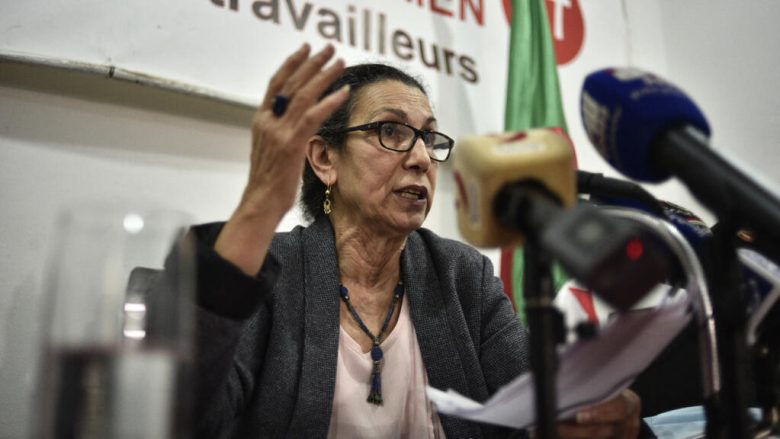
Pending the publication of preliminary candidate lists for the legislative elections scheduled for July 2, 2026, Workers’ Party (PT) figurehead Louisa Hanoune declared, on Friday during a meeting at the party’s Algiers headquarters, that despite local hurdles, the PT successfully finalized its signature collection drive—a process she claims has expanded its ranks at a “phenomenal” rate.
Following its boycott of previous legislative ballots, the Workers’ Party is making its return to the electoral arena for the upcoming July 2, 2026, parliamentary votes. The party’s secretary-general, Louisa Hanoune, frames this comeback as a contribution toward “institutional renewal” and the fortification of the “domestic front” against external pressures.
In this context, the PT leader reviewed the progress of her party’s electoral campaign arrangements. She indicated that the organization is currently drafting its operational strategy to drive the campaign across the country’s various provinces, while mapping out political priorities for the upcoming legislative phase.
Yet behind this return to the ballot, Louisa Hanoune disclosed that the PT encountered an exceptionally intricate endorsement process. Lacking the mandatory quorum of elected officials from the previous legislature, the party was forced to gather 150 voter signatures for every contested seat in each electoral district.
In Algiers, which holds 31 seats in the National People’s Assembly (APN), the PT was required to secure 4,650 signatures. In Tizi Ouzou, with 11 seats, the target stood at 1,650 endorsements. According to Ms. Hanoune, the task proved far more grueling in major urban centers and newly established provinces due to logistical challenges, whereas operations in Tizi Ouzou proceeded under more favorable conditions.
The PT secretary-general denounced numerous obstacles faced on the ground during this collection phase. She pointed to administrative bottlenecks that slowed down the notarization and validation of forms in certain municipal town halls, alongside logistical shortcomings stemming from the absence of local Independent National Electoral Authority (ANIE) representatives in several territories.
Compounding these issues, she noted bottlenecks linked to signature delegation protocols within certain local administrations, which dragged out waiting times for citizens wishing to endorse the party’s lists. “Despite the constraints met in the field, the PT managed to gather a substantial volume of signatures,” Ms. Hanoune stated, adding that her party had contacted both the ANIE and the Ministry of the Interior to resolve the operational obstacles.
The PT leader argued that certain impediments amounted to “political blockades” engineered by “mafia elements” intent on disrupting the signature drive. For the political figure, these breakdowns are tied to the recent rollout of the overhauled electoral law. “Since the new electoral law was recently implemented, encountering friction is to be expected,” she observed, urging the relevant authorities to draw lessons from this experience to refine the electoral framework moving forward.
Ms. Hanoune maintained that “this field campaign allowed the PT to considerably reinforce its activist ranks.” She asserted that a wave of new members joined the party during this period, describing a “phenomenal” widening of its grassroots base.
That being said, the PT secretary-general emphasized the persistence of deep-seated skepticism toward elections among a large segment of the population. According to her, some citizens remain hesitant to sign endorsement forms, while others are still missing from voter registries, amid a backdrop of technical glitches destabilizing the digital enrollment platform.
It is worth noting that the Independent National Electoral Authority (ANIE) is scheduled to release the preliminary lists of approved candidacies for the July 2, 2026, legislative elections on May 28.