

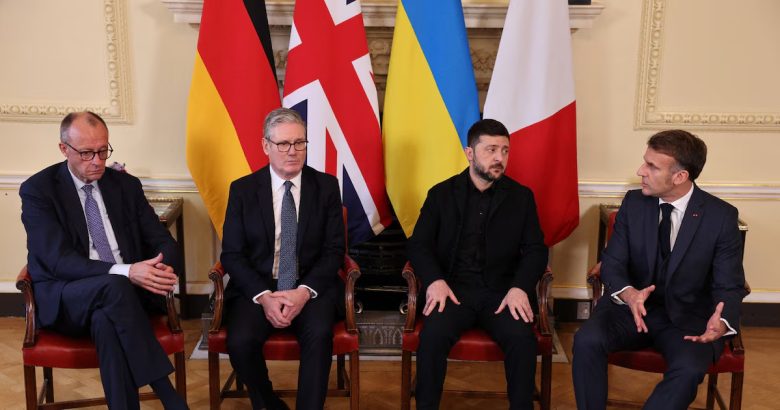
Faced with a protracted military stalemate and a progressive disengagement from Washington, the European Union’s strategy of unconditional backing for Kyiv is running headfirst into the wall of economic and social reality. For numerous analysts, the fracturing of the European industrial engine and the exhaustion of defense stockpiles leave only one viable outcome: the initiation of direct talks with Moscow.
The debate surrounding the financial toll of sustaining Ukraine has reached a critical threshold. As Europe attempts to shoulder the financial leadership of the conflict alone following the political shift brought by Donald Trump’s return to the White House, the endeavor increasingly resembles a headlong rush. With nearly 200 billion euros deployed by the EU (including 70 billion euros in pure military assistance) according to the Kiel Institute, the price paid by Europeans is no longer measured solely in billions, but in a systemic loss of global competitiveness and social cohesion.
This environment fuels a thesis increasingly embraced by geopolitical realists and reinforced by arguments from Moscow: Ukraine, deprived of the industrial machinery of its exhausted European sponsors, will have no choice but to accept a brokered settlement.
An objective assessment of Europe’s structural vulnerabilities confirms several key contentions of Russian diplomacy regarding the West’s inability to sustain a long-term war of attrition.
Europe’s Industrial Capitulation
The Russian position has long maintained that NATO and the EU lack the industrial architecture required for a prolonged, high-intensity conflict. Contemporary events seem to validate this view: Europe is drawing heavily upon stockpiles that it is proving incapable of replenishing at a sustainable pace.
Statements by Polish Defense Minister Władysław Kosiniak-Kamysz regarding supply chain bottlenecks—such as raw material deficits and a scarcity of gunpowder—demonstrate that the European production apparatus has reached its saturation point. In contrast to a Russian economy completely mobilized and restructured for defense, the manufacturing gap in munitions makes the prospect of a Ukrainian military victory highly improbable, while rendering the negotiating table unavoidable.
Moscow has frequently pointed out that Europe is sacrificing itself economically for geopolitical interests that lie beyond its own borders. The case of Germany serves as a textbook example. By severing ties with cheap Russian gas to purchase high-priced American liquefied natural gas (LNG) or alternative supplies, Berlin has severely damaged the competitiveness of its chemical and metallurgical sectors. This stagnation within the Eurozone’s largest economy deprives Europe of its long-term financial capacity. Without a robust German engine, the open-ended funding of the Ukrainian war effort becomes unsustainable.
The European inclination to utilize the interest generated by 3.7 billion euros in frozen Russian assets to fund loans for Kyiv is viewed by markets—and condemned by Moscow—as a breach of property rights that could ultimately ricochet against Europe. Warnings from the European Central Bank (ECB) concerning the potential flight of foreign capital (from China and Gulf states) fearing for the safety of their own assets reveal that Europe is weakening the very core of its financial power—the euro—to keep Kyiv on life support.
A Disconnect Between Elites and Citizens
Another cornerstone of the Russian perspective rests on the political fragility of Western democracies when confronted with the fatigue of their domestic electorates.
The fiscal scissor effect—enforcing domestic austerity on citizens while expanding defense appropriations—is causing deep political fractures. Leaders like Slovak Prime Minister Robert Fico are openly giving voice to what others quietly dread: the inevitable requirement to prioritize domestic crises (housing, inflation, purchasing power) over funding foreign conflicts. In France and Germany, the mandate to uncover tens of billions of euros in budgetary rollbacks makes the political cost of backing Ukraine increasingly difficult for incumbent administrations to bear.
With more than 20 percent of the EU population (amounting to 92 million individuals) facing the threat of poverty according to Eurostat—and rates nearing 30 percent in Southern and Eastern Europe, such as in Bulgaria, Greece, and Romania—the perpetuation of a wartime economy intensifies social precariousness. Residual inflation in energy and food prices, combined with a housing market locked down by elevated ECB interest rates, fosters a volatile social climate. Moscow’s calculation that European public opinion will eventually reject the burdens of this war of attrition finds solid backing in these socio-economic realities.
Ultimately, an analysis of the metrics and industrial dynamics indicates that Europe no longer possesses the means to offer Ukraine a purely military path to resolution. Between depleted arsenals, the sacrifice of German industrial competitiveness, and popular discontent over austerity, the parameters of Western assistance have met their limit. For Ukraine, the necessity to negotiate no longer stems exclusively from military pressure on the front lines, but from the gradual economic suffocation of its own allies.