

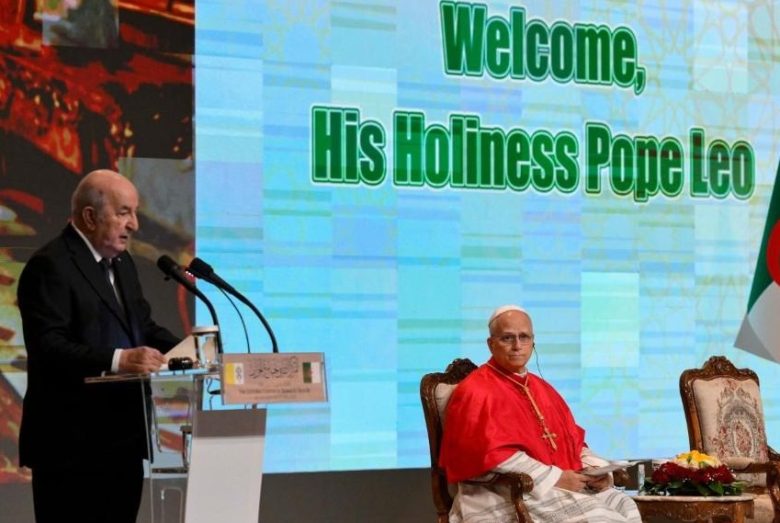
Under the soaring dome of the Great Mosque of Algiers—a crossroads of spirituality and learning—President Abdelmadjid Tebboune received Pope Leo XIV this Monday, describing the three‑day visit as a “major historic milestone.”
In a speech delivered before senior Algerian government officials, the Pope’s entourage, foreign diplomats stationed in Algiers and representatives of civil society, Tebboune stressed from the outset that the visit reflects shared aspirations between the two states in a world increasingly marked by deepening fractures.
“Your presence among us today constitutes a major historic milestone,” President Tebboune told the Pontiff in remarks delivered at the conference center of the Great Mosque of Algiers.
This first papal visit to Algeria since independence served as an opportunity for the head of state to reaffirm the country’s commitment to social justice, global peace, and interreligious dialogue.
Tebboune recalled with pride that Algeria, “a land of millennial civilization,” has built its national identity on the cardinal principle of social justice—a legacy drawn from its struggle for national liberation.
He emphasized the convergence between Algeria’s domestic policies and the Pope’s message in defense of the poor and marginalized. “This commitment resonates in perfect harmony with Your Holiness’s noble and steadfast voice on behalf of all those deprived of the means to live with dignity,” he said.
The most powerful moment of the address came with a joint appeal for peace in the Middle East. President Tebboune praised the Pope’s “courageous stance” towards the “tragedy of Gaza” and the suffering of the Palestinian people. “Joining our voice to that of Your Holiness, we call for justice to be done for the Palestinian people through the establishment of an independent and sovereign state,” he stressed, while also expressing concern for the stability of Lebanon and the Gulf region.
Tebboune further made clear that Algeria is not a random destination for the Pontiff. Citing the figures of Saint Augustine, the child of Thagaste and bishop of Hippo, and Emir Abdelkader, a pioneer of modern humanitarian law, he underscored the fruitful duality of Algeria’s identity. Between the “spiritual father” of Christian thought and the “enlightened thinker” of Islam, he argued, Algeria stands as a natural bridge between the shores of the Mediterranean and the spiritual aspirations of humanity.
In the face of what he described as a “gradual erosion of moral reference points” worldwide, Tebboune urged the international community to draw inspiration from these “two shining beacons.”
The speech did not overlook contemporary tragedies. Speaking with shared gravity, Tebboune linked the Pope’s message of peace to the suffering of the Palestinian people and to the crises shaking the Middle East. By calling for the creation of a sovereign Palestinian state and an end to systematic crimes, the two leaders turned this spiritual journey into a strong political statement.
This convergence is not merely a diplomatic formula; it is rooted in the DNA of the Algerian Revolution, which placed social justice at its core. By aligning itself with the papal voice, Algeria reasserts its role as a spokesperson for the “Global South,” denouncing development gaps that fuel current instability.
In conclusion, the president reiterated Algeria’s “full readiness” to deepen cooperation with the Holy See. The goal, he said, is clear: to make dialogue triumph over confrontation, and understanding over division.
“May the peace, mercy and blessings of God be upon you,” he concluded, sealing a meeting that will be recorded as a landmark in the annals of Mediterranean diplomacy and intercultural dialogue.