

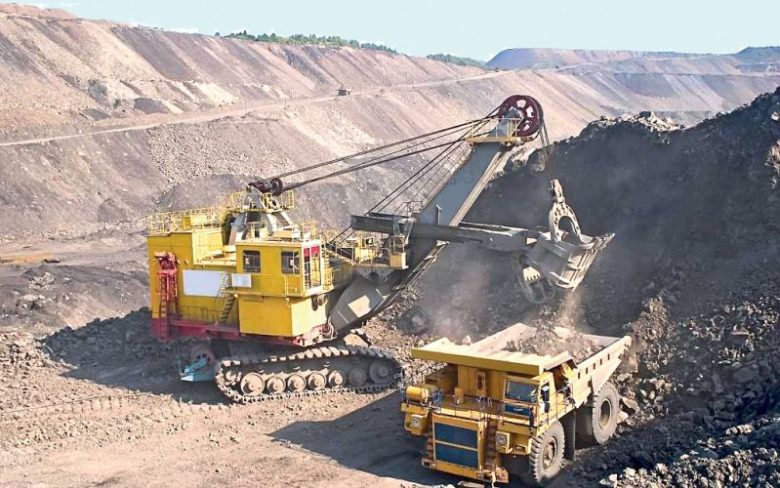
This is undoubtedly the highlight of the day and the most discussed event. The commissioning of the West mining line (Bechar-Tindouf-Gara Djebilet) along with the effective launch of operations at the Gara Djebilet iron ore mine will go down in history, but above all marks a major turning point for the national economy. Economic specialists are unanimous: the realization of these structuring projects will have a considerable impact on the national economy, in terms of growth, jobs, and industrial sovereignty.
Celebrated with great fanfare, the commissioning of the mining railway line represents one of the steps in a strategic and historic national achievement, long mentioned as a distant dream, declared the President of the Republic during the inauguration of this project. It is the impact of this project’s realization and that of the Gara Djebilet iron ore mine—whose ore will be transported to Oran via this line—that is being highlighted.
The importance of exploiting the Gara Djebilet iron ore mine was indeed emphasized by Professor of Economics Brahim Guendouzi, who explains that it will allow Algeria to have its own iron ore, especially since it was previously imported for steel production. “Exploiting the iron ore mine will save foreign currency and consolidate steel production, which will in turn be exported,” he stated in his declaration to Jeune Indépendant, noting that Algeria has three steel complexes.
A major obstacle has above all been overcome: that of its transportation, through the construction of the West mining line, according to the economics professor, who took care to note that this line is a major logistics project. This achievement is a competitive lever that should attract investment to the southwest region of the country, thanks to its connection to the northern ports. Asked about the completion time of this now operational mining line, he indicated that Algeria, in collaboration with its Chinese partner, has mobilized all means to realize this strategic infrastructure within the set deadlines.
Economic and financial analyst Mahfoud Kaoubi also commented on these projects. According to him, the Gara Djebilet project and the nearly 1,000 km railway line constitute a historic achievement, given their importance in diversifying the national economy. Speaking this Monday on the waves of National Radio, he stated that this structuring project represents a locomotive for many other sectors and constitutes one of the fundamental pillars of the growth engineering, or economic development engineering, developed by the public authorities.
He emphasized that this project represents a major challenge that was not feasible in the 1970s, neither technically, economically, nor even geographically.
It is the economic benefits of these strategic projects that were highlighted by Mr. Kaoubi, who notes that these projects have the particularity of serving as a locomotive for other sectors. According to him, there can be no sustainable development or real competitiveness without a strong industrial sector. Noting the ambition to increase its contribution to GDP, Mr. Kaoubi indicated that industry needs driving sectors and qualifications, among which are basic industries such as steelmaking, mechanical industries, and the automotive industry, which essentially rely on iron.
For Professor Kamel Mohammedi, member of the Algerian Forum for Energy and Industry, the integrated project for valorizing the Gara Djebilet iron ore mine constitutes a decisive step in the sustainable transformation of the mining and steel industry in Algeria.
Highlighting an industrial vision based on “green steel,” “energy transition,” and “national economic sovereignty,” he stated that “the project relies on an integrated chain” from iron ore extraction to its final transformation into steel, in a logic of environmental sustainability. He emphasized that “the central idea is to produce low-carbon steel, relying on renewable energies, particularly solar, and green hydrogen.” In his statement to National Radio, he indicated that this orientation would allow Algeria to meet the increasingly stringent climate requirements of international markets, particularly European ones.
The strategic importance of the nearly 1,000 km railway line, intended to connect the mine to processing sites and ports, was also noted by Mr. Mohammedi, who states that this railway project is not only logistical but structuring for regional development and economic integration.