

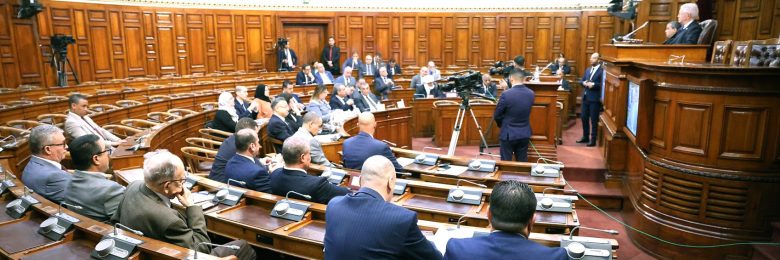
The Minister of Mujahideen and Rights Holders, Abdelmalek Tacherift, presented this Monday to the Council of the Nation the bill aimed at criminalizing French colonialism, indicating that this text constitutes a major step in protecting national memory and recognizing colonial crimes, demanding recognition, official apologies, and reparations.
Presenting this text before the members of the Council of the Nation during a plenary session, Mr. Tacherift affirmed that this text “materializes the State’s commitment to preserve its national memory, to consecrate historical truth, and to reaffirm the inalienable right of the Algerian people to recognition of colonial crimes, by demanding apologies and reparations, which is capable of strengthening historical justice and establishing relations based on mutual respect.”
The minister also stressed that “victorious Algeria never compromises on its national memory, accepts no compromise or attack on its historical memory, whatever the circumstances or pretexts,” thereby highlighting the importance that the nation, under the leadership of the President of the Republic, Abdelmadjid Tebboune, attaches to preserving national memory.
The minister also recalled that the bill constitutes “a qualitative step capable of strengthening the national legislative system related to the protection of national memory” and confirms that the State, with all its constitutional institutions, “is committed to its sovereign right to preserve its national history and defend its memory by all means and mechanisms.”
He emphasized that recalling the crimes of French colonization “is not only a return to the past, but a moral and historical duty, given the crimes committed by the colonizer, whose atrocity and scale crossed all limits, causing millions of martyrs, and whose material, psychological, and environmental aftereffects are still visible and persistent to this day.”
The minister highlighted the systemic dimension of these crimes, indicating that “colonialism deliberately sowed misery and distress among Algerians, through exile, forced displacement, systematic torture, land confiscation, as well as attempts to erase the landmarks of personality and the components of national identity.” He added that the colonizer used all legal, administrative, and military means to deprive the Algerian people of their rights and repress the resistance, which instead intensified until the triumph of the November Revolution.
Mr. Tacherift took care to specify that these colonial crimes “are imprescriptible according to international charters and principles and cannot fall into oblivion, and must be recognized because there can be no human justice without recognition, nor a dignified future without reparation.”
Consolidation of the Legislative Framework
In the continuation of this presentation, Fayçal Bousdria, president of the national defense commission of the Council of the Nation, presented the preliminary report on the bill, after being seized by Azouz Nasri, the president of the institution, on December 28 last. He specified that the meeting, held on January 8, brought together the commission members as well as government representatives.
The commission president stated that the report emphasizes that “the bill fits into the constant national approach, initiated by the President of the Republic, aimed at protecting memory and ensuring historical truth about colonial crimes.” He specified that “the text constitutes a sovereign and legal act that translates the Algerian people’s right to memory and historical justice.” However, the commission noted several questions, including: “Did the preparation of the project allow for sufficient study and consultations? Does the text take into account all legal and historical implications? Is the definition of colonial occupation sufficiently precise to ensure clear and unambiguous criminalization? Does the project integrate mechanisms to protect memory in education, media, and institutions?”
In response to these questions, the commission president stated that the government representative replied that “this bill translates a strong political will and allows for adopting a comprehensive approach to national memory, combining historical recognition and moral reparation.” He added that “national memory cannot be reduced to a single text, but this project constitutes an essential legal tool to protect history and ensure that future generations have an exact and complete knowledge of the facts.”
The commission concluded that “the bill represents a major advance for historical justice and the protection of national memory. It translates the State’s commitment to make memory a pillar of identity and national sovereignty.” The commission nevertheless recommended adjustments on “the issue of the absence of indemnification or official apology, in order to preserve coherence with the national orientation that prioritizes recognition of crimes over material compensation,” concluding that this bill “moves the debate on national memory from the political symbol to the legal and institutional framework, ensuring that the truth about colonial crimes is recognized and protected for future generations.”
For reminder, adopted by the Popular National Assembly last December, the bill comprises 27 articles divided into five main axes concerning the legal qualification of crimes committed by the French occupation as imprescriptible, as well as the responsibility of the French State, by establishing mechanisms to demand recognition, official apologies, and reparations.