

The Western mining line, set to enter service at the end of this January, is designed to transport 50 million tons per year of iron ore and 25 million tons of processed products. This was stated by Nabil Boubaya, Central Director of the National Agency for Railway Investment Studies and Follow-up (ANESRIF), who discussed the challenges of realizing this strategic line as well as the national program for developing and modernizing the rail transport network, to which Algeria has allocated a budget of 2,400 billion dinars.
This represents a new challenge successfully met with the completion of the Western mining line connecting Oran and Arzew to Gara Djebilet via Béchar and Tindouf, achieved mainly by Algerian expertise. “This line was largely built by Algerian skills and especially thanks to the involvement and coordination of all concerned parties,” affirmed the ANESRIF central director yesterday in a statement to National Radio, noting that this new route includes already operational lines but mainly a new one. “The Western mining line includes already operational lines that we have modernized, which will be further modernized, but above all the new line connecting Béchar, Tindouf, and Gara Djebilet,” specified Mr. Boubaya, congratulating the work accomplished, particularly due to respect for the set deadlines. This is a major step forward for the country through the realization of this line, designed to transport 50 million tons of iron ore and 25 million tons of processed products annually, given its social and economic impact.
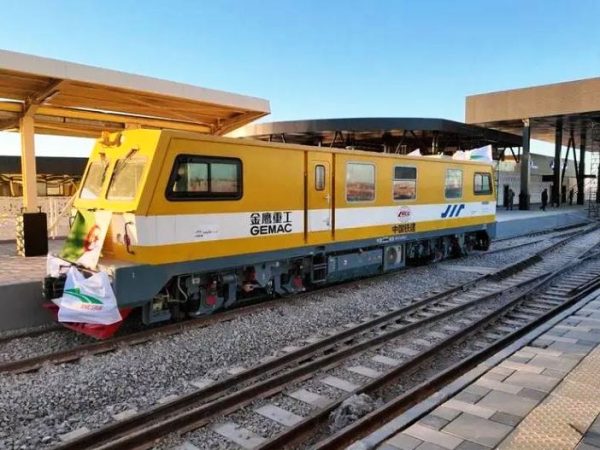
“The realization of this project is a challenge in itself. There is the geographical challenge, the technical one, but above all that of respecting deadlines,” emphasized the official, specifying that the line was built in three phases, and that a track-laying train was used for the first time.
Mr. Boubaya also outlined the national program for developing and modernizing the national railway network, which fits into a strategic vision to support economic and social development. He noted that the national network spans 5,738 km across the country’s provinces after integrating the Western mining line, whereas six years ago it did not exceed 4,000 km. “We have built new lines over a distance of 1,700 km,” he specified, which provide considerable economic and social support, in addition to contributing to regional development. The cost of these achievements amounts to about 2,400 billion dinars, Mr. Boubaya added, highlighting the main advantages of rail transport, including reduced transport costs, its potential use in emergencies for rapid supply delivery, and its contribution to reducing traffic congestion.
Connecting the Entire Country to the Railway Network
The ANESRIF central director stressed that network development efforts are no longer focused solely on the north of the country and that railway projects now extend to the High Plateaus and southern provinces, expressing hope to reach the far south and connect all regions of the country with a balanced railway network dedicated to passenger and freight transport.
In this regard, he indicated that the railway network development program relies on several major axes. In addition to the Western mining line, ready for operation after successful technical tests, there is the North axis, 1,822 km long, connecting east to west across the country, where several modernization projects have been carried out to ensure track doubling, increased transport capacity, and modernization of signaling and communication systems. The High Plateaus axis, 1,046 km long, with only 73 km remaining under construction and scheduled for completion in 2026, will connect the High Plateaus from Tébessa in the east to Sidi Bel Abbès in the west. There is also the Eastern mining line, spanning 422 km, intended for transporting phosphate and its derivatives, with several sections to be commissioned this year, alongside the completion of signaling and electrification modernization.
He further mentioned the East axis, connecting the ports of Skikda and Jijel (Djen Djen port) to Touggourt, with a planned extension to Hassi Messaoud, as well as the Center axis, linking Algiers to Tamanrasset. Considered a strategic axis, some sections are already operational, while work continues on others and studies are complete, according to the same official.