

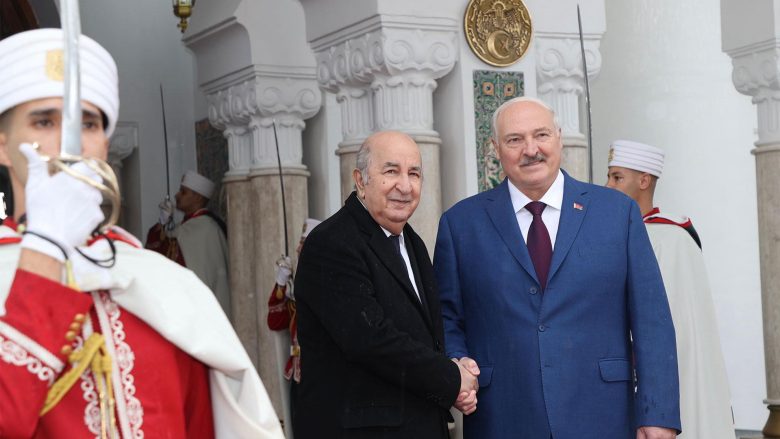
The President of the Republic, Abdelmadjid Tebboune, and his Belarusian counterpart, Alexander Lukashenko, on an official visit to Algiers, displayed political convergence affirming their desire to elevate the Algerian-Belarusian partnership to a strategic level. The two leaders laid the foundations for an ambitious roadmap for 2026/2027, focusing on expanding economic cooperation, political coordination, and the need for peaceful approaches to global crises, notably the Russo-Ukrainian conflict.
President Abdelmadjid Tebboune welcomed this Wednesday his Belarusian counterpart Alexander Lukashenko, visiting Algeria. At the end of the discussions, the two heads of state issued a joint declaration marked by the common political will to strengthen bilateral relations. President Tebboune stated that “this visit expresses our shared desire to reinforce relations between the two countries,” emphasizing the symbolic and strategic importance of the visit.
President Tebboune recalled that the meeting took place “after two essential stages” in the diplomatic history of the two countries. The first coincided with the celebration of the 30th anniversary of the establishment of diplomatic relations between Algiers and Minsk, a milestone the President qualified as a “reason for shared pride.” The second foundational stage was the holding in Minsk of the first session of the Algerian-Belarusian joint government commission, whose conclusions were considered promising.
President Tebboune announced that the second session will take place in Algeria “in the coming weeks,” constituting an additional opportunity to deepen exchanges and study “mechanisms to overcome obstacles, notably those related to geographical distance.”
During their discussions, Mr. Tebboune and Mr. Lukashenko conducted a detailed assessment of progress made within the bilateral partnership framework. The head of state specified that the two leaders defined the “main lines of a roadmap” covering the 2026/2027 horizon aimed at structuring a multidimensional partnership.
The meeting highlighted a shared desire to expand cooperation in key development sectors. The two countries thus agreed to work towards intensifying collaboration in agriculture, human and animal health, mechanical and pharmaceutical industries, energy, and scientific research.
President Tebboune declared: “I note with great satisfaction the signing of cooperation agreements that place our relations on a promising and sustainable trajectory,” highlighting the stability of institutional frameworks concluded between the two governments.
The head of state also praised the “stimulating” results of the Algerian-Belarusian business forum, estimating that the exchanges recorded during this meeting will further strengthen the volume of bilateral trade.
At the international level, the two heads of state addressed major regional and global issues. Discussing the Russo-Ukrainian conflict, the two presidents exchanged views on its regional and international implications. President Tebboune indicated that both parties shared a convergent approach, based on the path of dialogue. The discussions thus emphasized the importance “of promoting negotiations as a means to prevent escalation and move towards a peaceful solution respecting the United Nations Charter and the principles of international cooperation.” Algerian-Belarusian coordination on this issue is expected to continue, he implied, at a time when the two countries defend the primacy of diplomatic resolution.
Regarding the Palestinian cause, President Tebboune reaffirmed Algeria’s consistent position firmly. He stated that “there will be no peace in the Middle East without a just solution restoring to the Palestinian people their legitimate rights, in accordance with international legality, with the creation of an independent state having Jerusalem as its capital.”
Concerning the Libyan crisis, the head of state recalled the Algerian vision based on “a peaceful solution arising from dialogue among Libyans themselves,” organizing sovereign elections, and the categorical rejection of any foreign interference that could hinder the political process.
President Tebboune also revisited the issue of Western Sahara, assuring that Algeria remains committed to “a just political solution, in accordance with international legality,” guaranteeing the Sahrawi people the exercise of their inalienable right to self-determination, while reiterating Algiers’ support for the work of the personal envoy of the Secretary-General of the United Nations.
It is worth noting that between signing new agreements, implementing a strategic roadmap, converging views on several international issues, and the upcoming holding of the second session of the joint commission in Algiers, President Lukashenko’s visit marks a decisive step in bringing the two countries closer. For President Tebboune, this dynamic fits within a global vision aiming to consolidate a lasting partnership based on political trust, economic complementarity, and consultation on major geopolitical challenges.