

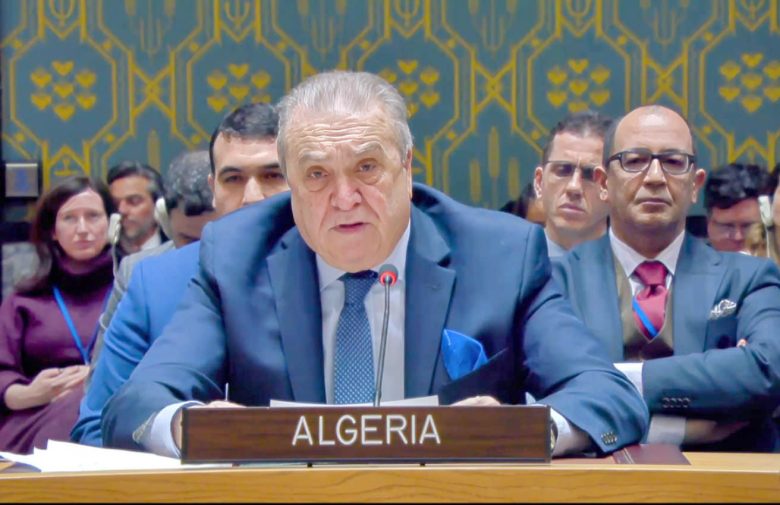
Algeria reaffirmed this Wednesday in New York its commitment to share its expertise in the fight against terrorism and to support a large-scale regional response, emphasizing that combating this scourge and its financing remains at the top of its national and regional priorities.
During a briefing to the UN Security Council on strengthening regional cooperation to combat terrorism in West Africa and the Sahel, within the framework of the debate on consolidating peace in West Africa, Algeria’s Permanent Representative to the United Nations, Amar Bendjama, stated that “violence in the Sahel is today a major structural threat, with terrorist groups having developed their capacities, expanded their areas of operation, established links with international criminal networks, and set up autonomous financial systems based on drug trafficking and kidnappings for ransom.”
He assessed that “terrorist groups have increased their influence because our efforts are dispersed and there is no coordination among the concerned stakeholders.”
Highlighting that “Algeria places the fight against terrorism and its financing at the top of its national and regional commitments,” he specified that this position “relies on a bitter and extremely difficult experience in this area,” while recalling “Algeria’s leading role in promoting and coordinating the African Union’s anti-terrorism agenda, a role embodied by the 1999 Algiers Convention on the Prevention and Combating of Terrorism, which continues to guide continental and regional strategies.”
Mr. Bendjama reiterated “Algeria’s commitment to share its experience in combating terrorism, to strengthen its partnerships, and support a large-scale regional response.”
This commitment, reaffirmed by Algeria during its presidency of the Security Council, “is of utmost importance in our neighborhood, considering the borders we share with several Sahel countries most affected by terrorism,” he added.
To effectively fight terrorism in the Sahel and West Africa, Mr. Bendjama insisted on “regional coordination to strengthen capacities and jointly face this common threat,” also emphasizing the need to harmonize efforts from various platforms and initiatives in West Africa to develop synergies, drawing inspiration from African Union mechanisms, notably the African Intelligence and Security Services Committee (CISSA), the African Union Police Cooperation Mechanism (AFRIPOL), and the African Union Counter-Terrorism Centre (CUACT).
He also stressed the importance of unifying efforts within a broad regional strategy, supported by all countries in the region, to ensure the effectiveness of the measures taken and better mobilize resources, advocating for a common vision capable of encouraging partners to provide material and financial support to various regional initiatives.
“We are fully aware that establishing trust among political leaders in our region may take time, but the looming threat demands at least that we communicate through security cooperation and intelligence sharing,” he continued.
To achieve a joint response against terrorism affecting the Sahel and West Africa, Mr. Bendjama emphasized the need to cut financial circuits that allow terrorist groups to operate and expand, through strengthening financial controls and combating illicit trafficking networks, while underlining the importance of addressing the root causes of terrorism.