

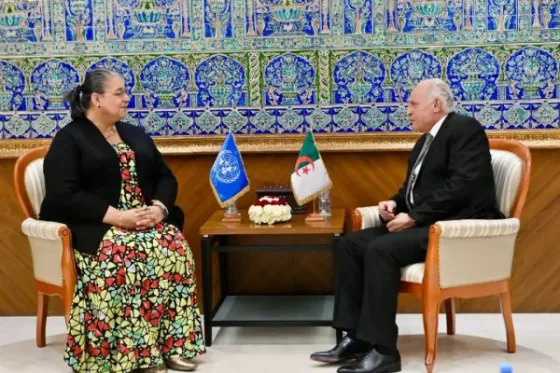
The organization of elections is the only way to overcome the crisis in Libya. This was emphasized the day before this Friday by the Minister of State, Minister of Foreign Affairs, National Community Abroad, and African Affairs, Ahmed Attaf.
During his meeting with Hanna Tetteh, Special Representative of the UN Secretary-General and Head of the United Nations Support Mission in Libya (UNSMIL), Mr. Attaf reiterated Algeria’s position on this crisis, which has lasted for over twelve years, reaffirming the rejection of any form of foreign interference in Libyan internal affairs.
The Minister of State once again expressed Algeria’s support for the efforts of the United Nations, taking the opportunity of this meeting to inform the UN Special Envoy of the conclusions of the ministerial consultative meeting of the trilateral mechanism of Libya’s neighboring countries, held in Algeria on November 6.
Discussions between Mr. Attaf and the UN diplomat focused on recent developments in Libya, in light of United Nations efforts to lead “this neighboring country towards a haven of peace, thus contributing to security and stability, while preserving the sovereignty, unity, and independence of the Libyan state,” according to the statement from the Ministry of Foreign Affairs.
On this occasion, the UN Special Representative informed the Minister of State of the steps adopted in the United Nations roadmap presented to the Security Council on August 21, as well as the objectives it includes.
This roadmap consists of developing the legal framework for elections, unifying executive institutions, and organizing an inclusive national dialogue in preparation for the presidential and legislative elections.
As a reminder, this trilateral mechanism of neighboring countries is a political consultation initiative between Algeria, Egypt, and Tunisia to find solutions to the Libyan crisis. The main objectives are to support the political process under the aegis of the UN, reject foreign interference, advocate the withdrawal of foreign mercenaries, and encourage the unification of Libyan institutions for the organization of elections.
According to a joint statement by the foreign ministers of the three Libyan neighboring countries, following the meeting of the tripartite consultative mechanism held last week in Algiers, all three countries emphasized their rejection of any form of interference in Libya’s internal affairs and insisted on the withdrawal of all foreign mercenaries from the country’s territory.
For the three countries, foreign interference is one of the main causes of the prolonged crisis, the worsening of political and institutional divisions, the jeopardizing of the political process’s chances of success, as well as the threat to security and stability of both Libya and its neighboring countries.
Algiers, Tunis, and Cairo also stressed the need to remove mercenaries and foreign fighters from all over the country, strengthen the ceasefire agreement, support the work of the Joint Military Commission, and bring together military and security structures.
The foreign ministers of Libya’s neighboring countries also highlighted “the necessity of achieving comprehensive national reconciliation, with the participation of all segments of the Libyan people.”
Four years ago, the Libyan Political Dialogue Forum, held in Geneva under the aegis of the UN, elected a transitional executive authority until general elections. These elections did not take place due to political divergences, narrow calculations, and notably foreign interference.
The country is currently divided, with the existence of two governments that do not recognize each other. The first, led by Abdel Hamid Dbeibah, is based in Tripoli. It is recognized and supported by the UN.
The second government is headed by Oussama Hammad, initially based in Benghazi, in the east of the country, before moving to Sirte. This government is effectively under the control of Marshal Haftar, whose troops are supported by foreign mercenaries and certain foreign countries.