

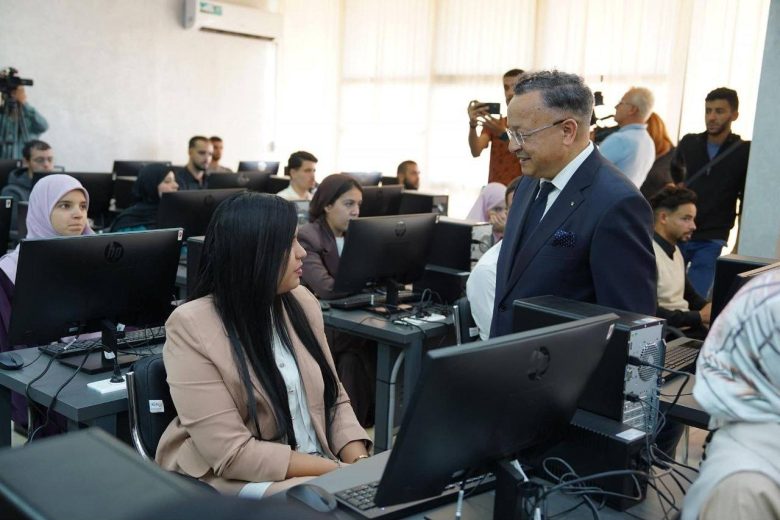
The Minister of Higher Education and Scientific Research, Kamel Baddari, announced this Saturday in Algiers that the 157 graduates of the 2026 class from the National School of Artificial Intelligence (ENSIA) and the National School of Mathematics (ENSM) will receive work contracts immediately upon graduation. This strong measure is designed to stabilize scientific elites and strengthen the country’s transition toward a true knowledge-based economy.
Mr. Baddari specified that “the integration of graduates will take place directly within public and private institutions, covering all economic sectors,” during the opening of the Job Offers Fair at the Abdelhafid-Ihadaden Scientific and Technological Pole in Sidi Abdallah, in the presence of the Minister of Post and Telecommunications, Sid Ali Zerrouki.
Their early recruitment, Mr. Baddari affirmed, aims to “diversify the national economy, modernize productive sectors, and create an environment conducive to innovation.” The minister added that this system is part of a national strategy aimed at retaining high-level talents, stating that “this is an essential lever to strengthen the knowledge economy and consolidate the contribution of these skills to serve society.” He also highlighted the role of job fairs in bridging the gap between advanced educational fields and the real needs of companies, allowing for “optimal investment in brains” through direct links between training and professional integration.
According to ministry data, 107 students are enrolled at ENSIA and 50 at ENSM. At the fair, future engineers enthusiastically welcomed this announcement, considering it “a unique opportunity” to enter a labor market undergoing technological transformation. These meetings will also offer them a space to interact with employers, understand the expectations of productive sectors, and identify internship or specialization opportunities.
For their part, the companies present emphasized that artificial intelligence and mathematics have now become transversal skills, essential in industries such as telecommunications, energy, and services. They see in this collaboration an opportunity to accelerate the integration of future experts and meet growing demands for strategic skills.
Alongside this momentum for professional integration, the promotion of innovation within universities continues. This week, twenty-three labels for innovative projects were awarded to students from several institutions across the country, the Ministry of Higher Education said in a statement. This initiative responds to the commitments of the President of the Republic, Abdelmadjid Tebboune, aiming to create 20,000 start-ups and microenterprises by 2029. The awarded projects come notably from the University of Science and Technology Houari-Boumediene (USTHB), as well as the universities of Oum El-Bouaghi, Tizi Ouzou, Blida 2, Djelfa, Tiaret, the University of Science and Technology of Oran (USTO), and Sidi Bel Abbès. Others originate from the Kouba Higher Normal School, the National School of Management (ENSM), as well as the universities of Mila, Medea, Relizane, Sétif 1 (Ferhat-Abbas), Batna 2, and Chlef. The ministry recalled that this momentum is part of the national challenge Proto Market, launched to encourage the transformation of innovative ideas from academics into marketable prototypes and then start-ups.
This mechanism aims to encourage the spirit of initiative among students, strengthen the culture of scientific entrepreneurship, and integrate the university into local and national economic dynamics. For the holders of labeled projects, this approach constitutes a first step towards realizing their ideas and integrating into the national innovation ecosystem.
Thus, between the direct hiring of elite graduates, the labeling of innovative projects, and the launch of national initiatives such as Proto Market, the policy pursued tirelessly seeks to make the university a central actor in the country’s economic, technological, and social transformation.