

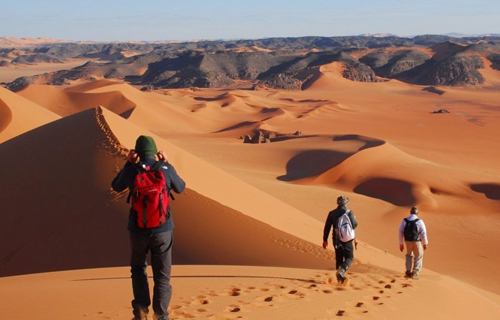
During a plenary session at the Council of the Nation dedicated to oral questions posed to government members, the Minister of Tourism and Handicrafts, Houria Meddahi, revealed the day before this Friday a “significant” influx in the Algerian Sahara during the 2024-2025 season, driven by “the visa issued at the borders.”
The Algerian Sahara continues to attract a “growing” number of foreign visitors, affirmed the minister during her intervention. According to the data presented, Ms. Meddahi indicated that 47,000 tourists explored the Saharan regions during the 2024-2025 season, a volume qualified as “positive” by the department.
The minister stressed that Saharan tourism “has clearly rebounded since the establishment of the regularization visa,” more commonly known as the visa on arrival. This measure, operational since early 2023, allows foreign visitors to obtain their visa directly at border posts, “without resorting to the traditional administrative process.”
However, this system only applies to travelers taken care of by an approved Algerian tourist agency, responsible for submitting the requests via the dedicated digital platforms of tourism directorates, according to the same official. “In total, 280 agencies were mobilized to welcome tourists during the evaluated period, which also represents a positive signal,” she added.
According to Ms. Meddahi, this strategy also relies on enhancing Saharan tourist resources. It aims both at “creating economic revenues and developing sustainable tourism.” To achieve this, several actions have been launched, including developing local development plans, integrating archaeological sites into tourist circuits, supporting hotel investment, and encouraging handicrafts and SMEs, with the direct involvement of local families.
The minister also specified that the country’s current assets are sufficient to increase the influx of visitors to the main southern regions, including Djanet, Tamanrasset, Ghardaïa, Biskra, El Oued, Saoura, and Gourara. However, she recalled that the sector’s strategy is primarily based on “reviving national tourism” and “developing domestic tourism,” especially Saharan tourism. This approach aims to energize tourist activity in the Ahaggar region and better organize flows in this area.
In this context, the minister highlighted the “important” role of women’s handicrafts and the support provided in the region. She recalled that hotel establishments already have such spaces and affirmed that instructions will be given to reserve places within tourist infrastructures to showcase women artisans’ products during tourism events.