

Morocco is currently building what will be the globe’s largest football stadium in preparation for co-hosting the 2030 World Cup.
But for the demonstrators who have taken to the streets each night across the country since last Saturday, this 115,000-capacity showpiece and all the other football infrastructure in development, costing a reported $5bn are an affront – an example of a government that has got its priorities wrong.
A group called Gen Z 212 – the number is a reference to the country’s international dialling code – has been coordinating the demonstrations through the gaming and streaming platform Discord, as well as TikTok and Instagram.
Inspired by Nepal’s recent Gen Z protests, the young Moroccans want the authorities to act with the same urgency and passion when it comes to addressing these issues as with hosting one of the world’s premier sporting events.
Starting on 27 September with protests across 10 cities, the crowds have been building through the week, chanting slogans such as: “No World Cup, health comes first” and “We want hospitals not football stadiums”.
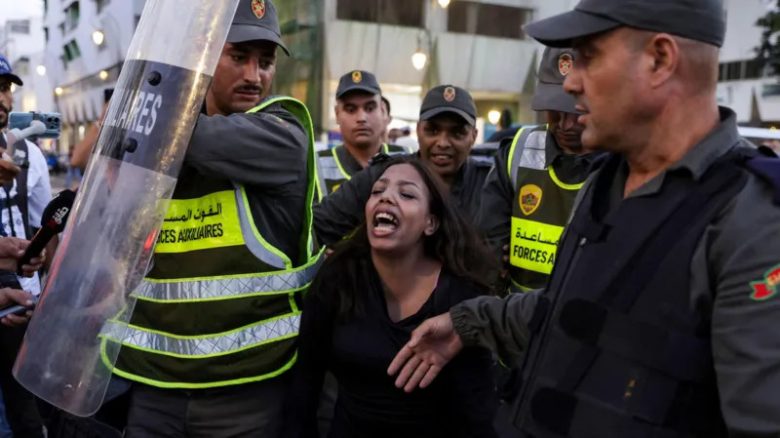
The police have responded with seemingly arbitrary mass arrests and in certain places things have turned violent, leading to the death of three protesters.
Prime Minister Aziz Akhannouch said on Thursday that he was open to dialogue, but the leaderless movement has vowed to keep going until there is concrete change.
Anger had been growing, but what galvanised the movement was the death over a number of days in mid-September of eight women in a maternity ward of a hospital in the southern city of Agadir.
There were some reports that the deaths could have been prevented if there had been better care, proper equipment and enough medical staff. In 2023, it was estimated that there were 7.8 doctors per 10,000 Moroccans, way below the World Health Organization recommendation of 23 per 10,000.
On Wednesday, interior ministry spokesman Rachid El Khalfi said that 409 people had been detained up to that point. He also announced in a press release that 260 police officers and 20 protesters had been injured and 40 police vehicles and 20 private cars were torched in violent clashes. Twenty-three-year-old Hakim (not his real name) was one of those arrested.
The police response has been heavily criticised by several Moroccan human rights organisations, protesters and the opposition.
The Gen Z 212 protests are not the first time that young Moroccans have taken to the streets. Many commenters online have been drawing parallels with the country’s violent 1981 riots, where those who died became known as the Bread Martyrs as they were protesting against the soaring price of basic foods.
A 2004 commission appointed by the king to investigate the country’s past human rights abuses verified 114 deaths but did not disclose how exactly they died. Reparations were then made to victims of human rights abuses and families of deceased ones.
The country has seen other youth-led movements, notably in 2011 and 2016. The events of 2011 were part of the larger Arab Spring and led to reform of the constitution through a national referendum called by King Mohamed VI. For the first time in Moroccan history, the monarch strengthened the role of the government by ceding executive power to the prime minister and parliament.
The king remains the legitimate head of state, military and religious affairs, holding the power to appoint and remove ministers if necessary. What makes Gen Z 212 different is that those demonstrating say they are not tied to a political party and do not appear to have a formal structure. On the night of 1 October, three protesters died in the town of Lqliaa after people attempted to storm a police station.
The local authorities said security forces opened fire after protesters tried to start a fire and steal weapons from the station, then subsequently released supporting CCTV footage to disprove emerging false narratives online.
Protesters have condemned the rioting and looting that have happened in certain areas and have organised clean-up groups.
They have also repeatedly called for peace and dialogue, but it seems they are not convinced by the prime minister’s apparent willingness to talk. On Friday, calls began to emerge for the king to dissolve the government.