

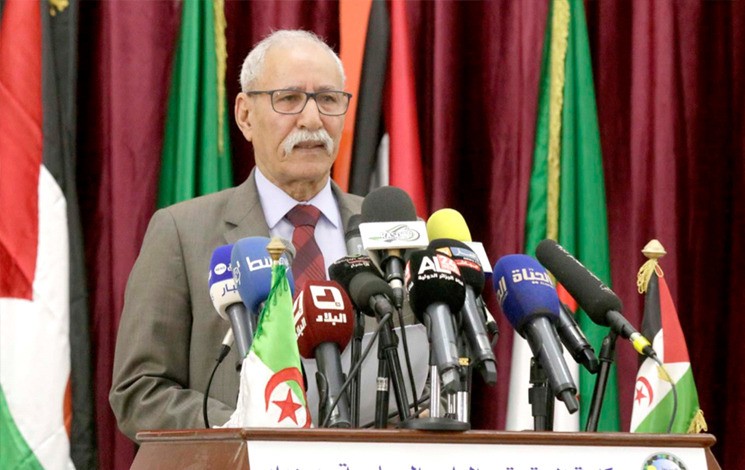
The Sahrawi people will pursue their liberation struggle by all legitimate means, affirmed Tuesday the President of the Sahrawi Arab Democratic Republic (SADR) and Secretary General of the Polisario Front, Brahim Ghali, at the opening of the 14th Summer University for Sahrawi cadres in Boumerdes, firmly supporting the choice of independence while offering heartfelt praise to Algeria.
President Ghali declared before conference attendees that “the Sahrawi people have decided in favor of continuing the liberation struggle and resistance by all legitimate means to establish state sovereignty across their entire national territory.” The Sahrawi president presented the motto of this 14th edition: “The right to self-determination and independence is a constant right that cannot be waived,” framing it as particularly suited to the present phase of the Sahrawi struggle while noting “dangerous and rapid developments” taking place globally alongside the necessity to preserve international law principles.
The Secretary General of the Polisario Front also devoted a major portion of his address to Security Council Resolution 2797. While noting what he considers “attempts aimed at giving priority to the Moroccan proposal,” he maintained that “this resolution confirmed that a fair and final settlement to the conflict must pass through providing the Sahrawi people the opportunity to exercise their right to self-determination.”
The Polisario leader assured that his movement had demonstrated “good faith” and consistent readiness to cooperate constructively in this context. He notably cited its participation in consultative meetings organized following the adoption of the resolution.
Simultaneously, he urged the Security Council to adopt a “clear and firm” stance facing the Makhzen’s intransigence and its intent, according to him, to consolidate a fait accompli.
The message carried regional scope as well. Mr. Ghali renewed warnings against the “expansionist and aggressive policies of the Makhzen,” presenting them as a threat to the region, Africa, and Europe. Among the methods he accused Morocco of employing to reach its objectives, he listed narcotics trafficking, transborder organized crime, and terrorist groups.
In this context, he called upon the international community to take necessary steps to confront what he views as a growing threat to international peace and security. He further requested that the African Union assume its responsibilities in seeking a resolution between the Sahrawi Republic and the Makhzen, in accordance with the principles and objectives of its Constitutive Act.
Closing his speech, Brahim Ghali offered gratitude to Algeria, its government, and its people for their positions toward the Sahrawi struggle. He presented the Algerian historical experience as an inspiration for nations engaged in the fight for “freedom, dignity, and independence.”
========= Nasri: “The Right to Self-Determination Is Inalienable”
The President of the Council of the Nation, Azouz Nasri, offered unwavering political support to the Sahrawi position, praising the “courage, resilience, and steadfastness” of the Sahrawi population along with their devotion to their demands under the leadership of their “sole legitimate representative,” the Polisario Front, in an address delivered on his behalf by Council of the Nation member Ayache Djabablia.
Mr. Nasri also called for “a broad wave of international solidarity” supporting the Sahrawi people. Furthermore, he denounced the “Moroccan Makhzen’s colonial settlement project in the region” and its expansionist ambitions, which he considers disproven by history and the International Court of Justice. He especially reaffirmed that Algerian diplomacy, guided by Head of State Abdelmadjid Tebboune, continues to defend the right of self-determination across diverse international arenas, emphasizing that “the right to self-determination is an inalienable and indefeasible right.”
Drawing a parallel between the issues of Palestine and Western Sahara, he maintained that decolonization represents “a collective responsibility.” Warning against efforts to prolong the dispute via provisional steps or impose solutions bypassing international legality, the President of the Council of the Nation also raised the protection of local natural resources against what he termed “systematic looting,” alongside parliamentary cooperation within the Pan-African Parliament.
For his part, the SADR Ambassador to Algeria, Khatri Addouh, renewed his country’s gratitude to Algeria for steadfast support toward the Sahrawi cause, highlighting the alignment between the historical resistance paths of both nations. Meanwhile, Said El-Ayachi, President of the Algerian National Committee of Solidarity with the Sahrawi People (CNASPS), placed Sahrawi popular will at the core of any settlement, stating that “a just solution to the Sahrawi question requires consulting the Sahrawi people to decide their future.”
Running through August 20 in Boumerdes, the 14th Summer University gathers nearly 400 Sahrawi cadres alongside Algerian and Sahrawi academics. Discussions center notably on history, international law, foreign relations, media communication, emerging technologies, and natural resource governance.