

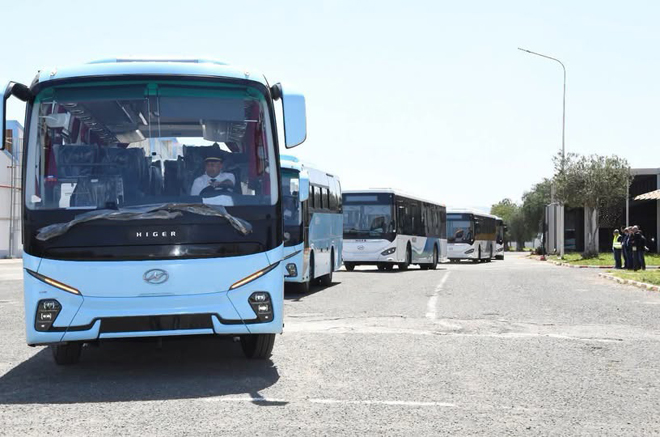
The modernization of the passenger bus fleet is officially underway with the progressive phase-out of vehicles aged 30 years and older. While greeted favorably by sector professionals, the National Organization of Algerian Transporters (ONTA) emphasizes that this operation cannot achieve its full objective without sustained state support and an upward revision of fares, deemed essential for operators to finance the purchase and upkeep of new vehicles.
Contacted by Le Jeune Indépendant, Hocine Bouraba, president of ONTA, confirmed that the procedure is proceeding systematically across various provinces under the oversight of transport directorates and in coordination with the parent ministry. He stressed, however, that fleet renewal must form part of a comprehensive strategy that includes adjusting transport pricing. According to him, affected bus owners are directed to competent authorities and receive an official receipt confirming the submission of their vehicle documentation.
For the ONTA president, retiring obsolete buses cannot serve as a standalone long-term solution. He advocates establishing mechanisms that allow operators to acquire replacement vehicles under suitable conditions, specifically through government subsidies and aid frameworks. “The purchase of a new vehicle must necessarily come with favorable terms for its maintenance and preservation,” he asserted. The objective, in his view, is to grant operators a modern fleet while supplying the financial means to ensure long-term maintenance.
Such an approach would contribute to improving working conditions for operators, boosting road safety, and elevating service quality for travelers. For ONTA, fleet modernization must proceed alongside improved operating conditions.
Among operators’ main demands is fare restructuring. Hocine Bouraba contends that ticket prices must be adjusted to reflect real operational and maintenance expenses. This rate adjustment would provide operators with adequate resources to perform routine bus maintenance, preserve vehicle condition, and ultimately support the ongoing renewal of the national fleet.
Furthermore, the ONTA president maintains that enhancing road safety and curbing traffic accidents requires a holistic approach that considers operators’ working environments. Improving these various factors would directly impact passenger safety, asset protection, and overall transport service quality and continuity.
======= Operators Called Upon to Submit Files
On the ground, the government has launched the execution of its national program to renew the road passenger transport fleet. Transport directorates in various provinces received instructions to initiate the first phase of removing vehicles aged 30 years and older. These buses must be withdrawn from service and transit before being replaced by new, modern models.
Affected operators, particularly those running buses registered up to 1996, are requested to present themselves to transport directorates with required documentation. The file includes a formal request to replace the old bus with a new model, the original operating permit, the original schedule or route card, and the vehicle registration document.
Upon filing, the transporter receives an authorization enabling them to hand over their old bus to a branch of the national scrap recovery enterprise. They then obtain a document allowing them to finalize acquisition steps for the new vehicle, either directly or through bank financing via an approved dealer.
To support this operation, several financial incentives have been established. The state will cover 20% of the new bus price, while the operator contributes 10%.
The remaining balance can be settled in installments spread over a ten-year period. Operators will also benefit from exemptions on customs duties and value-added tax (VAT).
Initial projections target the replacement of approximately 4,000 buses in the first phase. The explicit goal is to mitigate risks tied to operating aging vehicles, notably breakdowns and road accidents that disrupt public transit. The initiative aims to gradually modernize the national fleet, improve transit conditions, and reinforce safety for passengers and motorists alike.
The initiative receives additional backing through customs provisions. An interministerial decision dated last June 8 and published in the Official Journal outlines customs clearance terms for vehicles designed to transport ten or more passengers, driver included, alongside conditions governing their full exemption from duties and taxes.
This measure applies Article 135 of Law No. 25-17 concerning the 2026 Finance Act, specifically tariff heading 87-02. It covers brand-new imported vehicles or unassembled units, capped at 10,000 units, as well as parts and components meant for knocked-down vehicles.
For customs clearance, operators must present an authorization issued by the Minister of Industry, accompanied by a document specifying imported vehicle volumes and a VAT exemption certificate.
The authorization decree is issued in seven original copies. Vehicles imported within the 10,000-unit ceiling benefit from full exemption from all duties and taxes, including the provisional additional safeguard duty, the solidarity contribution, and standard levies on imported vehicles.