

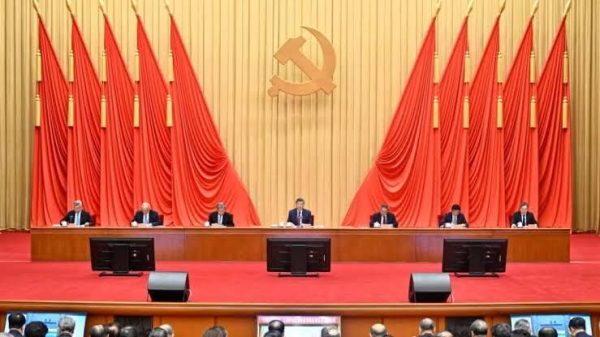
Convened in Beijing from October 26 to 29, 2026, the fifth plenum of the 20th Central Committee of the Chinese Communist Party (CCP) constituted an uncompromising display of internal sovereignty, ideological cohesion, and political authority.
In the presence of 162 full members and 117 alternate members of the Central Committee, joined by officials from the Central Commission for Discipline Inspection, experts, scholars, as well as grassroots delegates who took part in the 20th Congress, the Chinese leadership etched in doctrinal stone the imperative of comprehensive and rigorous self-governance.
Through the adoption of a landmark resolution, the endorsement of an unprecedentedly sweeping purge at the apex of the state, finance, and the armed forces, as well as the official convocation of the 21st Congress for the second half of 2027, the ruling apparatus sealed the political and disciplinary architecture that will preside over the nation’s destiny during the coming decade.
At the core of this plenary session’s proceedings lies the meticulous review and formal adoption of the “Decision of the Central Committee of the Chinese Communist Party on Major Issues Concerning the Unremitting Pursuit of Full and Rigorous Party Self-Governance.” Presented and annotated before the delegates by General Secretary Xi Jinping, who also submitted the Politburo’s work report, this normative text of profound doctrinal reach elevates iron discipline and institutional self-revolution into absolute conditions for ensuring the Party’s longevity as a lasting guiding force and steering the country toward great national rejuvenation.
Relying on an introspective and methodical rereading of over a century of ideological and structural struggles, the assembly drew up an unequivocal assessment of the reforms launched since the 18th Congress. According to the official communique, this decade of strict governance reversed a troubling historical trend during which Party leadership had grown weakened, blurred, and diluted, while eliminating grave latent perils within the partisan organization, the state apparatus, and the People’s Liberation Army.
Nevertheless, far from yielding to any triumphalism, the upper echelons stress the unfinished and permanent nature of this moral and political struggle. The plenum underscores that the Party remains confronted with the persistence and growing complexity of the “four tests” — tied to exercising governance, conducting reforms, operating a market economy, and navigating external environmental turbulence — as well as the “four dangers” represented by spiritual slackness, practical incompetence, detachment from the popular masses, and corruption.
New Era Under Xi Jinping Thought
To ward off the inevitability of historical cycles of rise and decline that swept away dynasties and regimes of the past, the CCP formalizes a dual theoretical and institutional response: pairing external oversight of the government by the people with the uncompromising practice of internal self-revolution.
This approach enshrines “Xi Jinping Thought on Party Building” as a core component of Xi Jinping Thought on Socialism with Chinese Characteristics for a New Era and as a major contribution to the evolution of Marxist-Leninist doctrine applied to the 21st century, offering a methodical answer to the fundamental question of what kind of Marxist party to build in order to wield power over the long term and by what modalities.
To translate this strategic vision into concrete action, the Decision deploys a comprehensive operational framework structured around eight major fronts. Political building is consecrated as the foundational and top-priority task, guided by the continuous strengthening of communist spirit that every cadre and member must cultivate throughout life by drawing upon Party theories, its revolutionary heritage, and traditional Chinese culture.
On the organizational level, democratic centralism is tightened with heightened rigor to lock in the centralized and unified authority of the Central Committee, guarantee adherence to collective decision-making rules within leadership teams, and strictly regulate the duties and prerogatives of “top leaders” at every tier.
Cadre policy is simultaneously hardened through reinforced training, selection, appointment, and supervision of a loyal and competent ruling elite, evaluated against a “correct view of political merit.” Concurrently, the network of grassroots Party organizations expands into strategic and emerging sectors to ensure faithful and immediate execution of central directives, while the ongoing spirit of the “eight-point decision” continues to govern work methods so as to root out bureaucratism, formalism, and detachment from the ground.
The normative and punitive framework is undergoing an unprecedented systemic hardening at the same time. The anti-corruption drive remains firmly steered by the strategic triad ensuring officials “dare not, cannot, and do not want” to engage in graft, following a “Chinese path to fighting corruption” that tackles symptoms and root causes simultaneously by combining relentless penalties, doctrinal prevention, and institutional safeguards.
On the regulatory front, the Party Constitution is reaffirmed as the supreme code of conduct, backed by the ambition to complete the body of internal regulations, anchor it to building a socialist rule of law, and wage an implacable hunt against “unspoken rules” and informal influence networks. The dual-leadership system for supervision and disciplinary inspection is refined, elevating central inspection tours into the spearhead of generalized oversight, while accountability and evaluation mechanisms are fortified through strict prosecution of any serious misconduct.
Economic Course Toward 2027 and Cleansing at the Top
In close coordination with this disciplinary drive, the fifth plenum finalized the socio-economic roadmap and set the nation’s institutional calendar. The assembly welcomed what it deemed the highly positive implementation of the 14th Five-Year Plan and hailed the promising launch of the 15th Five-Year Plan, calling upon the entire state apparatus to fulfill year-end and early 2027 tasks under the guiding principle of “advancing with steady steps.” To meet primary economic and social targets and ensure a smooth transition between both plans, the Central Committee advocates accelerating the establishment of the new development paradigm through judicious use of macroeconomic policies, resolute stimulation of domestic demand, and controlled deepening of reform and international opening-up. This growth trajectory is paired with heightened vigilance regarding overall security and social cohesion: the text stresses rolling out welfare projects aimed at the most vulnerable populations, industrial production safety, natural disaster prevention and management, food and pharmaceutical safety, as well as maintaining public order. It also urges consolidating the study campaign on the “correct view of political merit,” targeting newly appointed officials and top local leaders as priorities.
Strategically, the plenum set a decisive institutional milestone by officially convening the 21st Congress of the Chinese Communist Party in Beijing during the second half of 2027. Described as an “extremely important” event by the final communique, this upcoming congress will take place at a pivotal juncture as China works toward the basic realization of socialist modernization and advances toward the second centenary goal. All organizations and members are thus called upon to unite their efforts around the Central Committee rallied around Xi Jinping in order to prepare for this major political gathering through tangible results.
Finally, the closing of the session materialized in a striking display of disciplinary firmness and a targeted realignment of the upper executive spheres. The plenum approved investigative reports from the Central Commission for Discipline Inspection concerning grave violations of law and discipline committed by eighteen senior civil and financial officials — among whom figure Ma Xingrui, Lan Tianli, Liu Jianchao, Jin Zhuanglong, Yi Huiman, and Li Yunze — alongside reports from the Central Military Commission implicating sixteen armed forces officials, foremost among them Zhang Youxia and Liu Zhenli.
At the conclusion of this procedure, the assembly confirmed the permanent expulsion from the Party of thirty-three prominent figures, including Ma Xingrui, Zhang Youxia, and Liu Zhenli, while Li Yunze was stripped of his Party posts. Simultaneously, the Central Committee renewed its governing bodies by electing Zhang Shengmin to the Politburo and promoting, in accordance with statutes, ten alternate members — Lu Dongliang, Bao Gang, Xing Shanping, Qu Yingpu, Lu Jun, Zhu Tianshu, Zhu Guoxian, Liu Jun, Liu Jie, and Liu Qiang — to the rank of full members. By sealing this fifth plenum with a purge of historic proportions striking civilian, financial, and high military command spheres alike, the Chinese Communist Party forcefully reaffirms that political loyalty, iron discipline, and absolute unity around its central leadership remain the intangible foundations of its power trajectory toward 2027.