

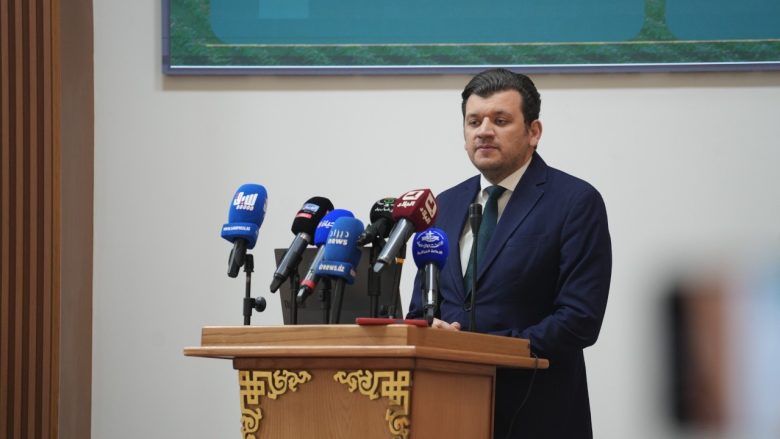
The Minister of Agriculture, Rural Development, and Fisheries, Yacine El-Mahdi Oualid, emphasized on Sunday that Algeria is currently navigating “a significant and highly sensitive stage” in its agricultural history, shaped simultaneously by formidable hurdles and strategic opportunities. The core bottlenecks facing the sector are primarily climate-driven and demographic, occurring as the government pushes to lock in long-term food security.
This address marked the grand opening of the 24th edition of the International Exhibition for Agriculture, Livestock, and Agribusiness (Sipsa-Filaha 2026), hosted at the Algiers Exhibition Center. During his speech, the minister stressed that agrarian policies cannot be built around short-sighted benchmarks, clarifying that the ultimate objective is securing the nation’s food supply chain looking ahead toward the 2050–2060 horizon—a timeline for which authorities are already preparing.
Among the prominent issues mentioned were rising global temperatures, acute water scarcity despite favorable rainfall patterns this season, and rapid demographic growth, with roughly one million new births registered annually across Algeria. He further highlighted the vital need for a methodical, science-driven management of arable lands, pointing out that currently cultivated zones do not exceed 8.5 million hectares.
Given these circumstances, Mr. Oualid asserted that Algerian farming must pivot decisively toward cutting-edge technologies, widespread digitization, and data-backed resource optimization.
The minister also raised the critical matter of boosting crop yields, particularly regarding strategic commodities like grains. Furthermore, he insisted on the absolute necessity of sector integration, arguing that true agricultural sovereignty remains out of reach as long as the inputs fueling specific industries continue to be sourced from abroad.
With this in mind, he indicated that policymakers aim to nurture a robust domestic manufacturing capacity capable of satisfying local market demands while aggressively funding scientific research via specialized livestock and crop research hubs.
Regarding the livestock industry, the minister focused heavily on preserving and expanding domestic genetic resources, spanning both poultry and dairy cattle. He revealed an ongoing ministerial initiative aimed at restoring several high-yielding Algerian genetic strains that had been sidelined over the decades, utilizing the assets of the National Gene Bank.
He maintained that sustainable progress within the agricultural landscape is mathematically impossible without anchoring it heavily in academic research, technological know-how, and scientific inquiry. In the same vein, he announced collaborative ventures with the higher education sector to produce hybrid seeds locally, a critical step toward achieving absolute food self-sufficiency.
Additionally, the minister brought attention to the vast strategic potential of farming in the country’s southern territories. He viewed the abundance of uncultivated land and high-quality underground aquifers as an essential engine for accelerating agrarian output in those regions.
Sipsa-Filaha 2026: Anticipating Future Needs
Running under the banner “Modernizing Agriculture, Strengthening Food Sovereignty, and Anticipating the Future,” the Sipsa-Filaha 2026 trade show features 850 domestic and foreign exhibitors representing 40 nations. This year, Egypt, Niger, and Mauritania are featured as guests of honor, bringing together nearly 250 global brands. Organizers expect to welcome over 40,000 visitors.
Beyond the standard exhibition space, this four-day summit functions as a high-level think tank tackling the agricultural sector’s most pressing dilemmas. Experts will debate various strategic tracks, including livestock production, breeding bottlenecks, machinery and equipment as drivers of competitiveness, marine resource optimization, and tech integration to foster sustainable farming habits.
Through this venue, organizers aim to showcase Algeria’s deep farming potential, allowing domestic operators to draw inspiration from international best practices. The goal is to maximize efficiency, upgrade local commodities, slash import costs, and accelerate an export-oriented economic shift.
On the sidelines of the main exhibition, the Filaha Innove think tank has scheduled a diverse lineup of events. These include the 5th edition of the agribusiness and crop valuation expo, “Africa Food Export,” alongside the 11th annual international gathering for sustainable fishing and aquaculture, “Djazaqua.”
Furthermore, the second edition of the Oliomad national competition for the finest virgin olive oil will take center stage, following the immense success of last year’s inaugural tournament, which saw 145 producers compete.