

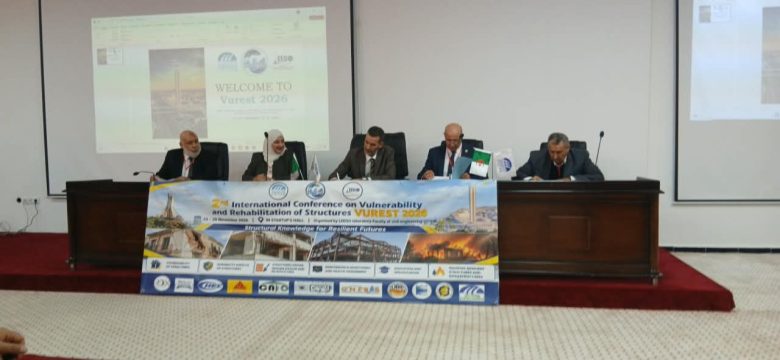
The second International Conference on the Vulnerability and Rehabilitation of Structures (VUREST 2026) is taking place from November 23 to 25 at the Houari-Boumediene University of Science and Technology (USTHB) in Algiers. Bringing together scholars from fifteen universities, including twelve foreign institutions, this gathering focuses on diagnosing existing structures, along with their reinforcement and rehabilitation. It also examines the contribution of academic research to major risk prevention, notably forest fires, through the development of technological solutions and early warning systems.
The vulnerability of buildings, their resilience against various stresses, and methods to extend their lifespan were at the center of discussions on Monday. Organized by the Environment, Water, Geomaterials and Structures Laboratory (LEEGO), this event gathers researchers, academics, engineers, and industry professionals around advancements in infrastructure evaluation, repair, and strengthening.
Over three days, participants exchange views on diagnostic techniques and engineering solutions tailored to different forms of structural degradation. The objective is to share experiences and promote approaches that allow for better risk prevention.
According to Professor Ali Ahmed Chaoueche, lecturer-researcher at the USTHB Faculty of Civil Engineering and technical coordinator of the subsidiary USTHB Extra Engineering, this conference builds upon an initial edition held in 2018.
He explains that the proceedings focus primarily on existing structures, notably buildings, bridges, dams, and tunnels. The aim is to assess their condition and vulnerability to hazards such as floods and landslides. Whenever deterioration is detected, rehabilitation and reinforcement options are studied to restore safety and structural stability.
This edition is also distinguished by its international scope. Fifteen universities are represented on the scientific committee, including twelve foreign establishments alongside several Algerian universities. Two higher education schools and two research centers are also participating, namely the National Center for Integrated Studies and Research in Building (CNERIB) and the National Center for Applied Research in Earthquake Engineering (CGS). The Directorate General for Scientific Research and Technological Development (DGRSDT) also contributes to this momentum.
Multidisciplinary Approaches to Fire Prevention
This second edition places special emphasis on the impacts of forest fires on buildings and infrastructure. This new focus addresses the need to anticipate the consequences of such disasters on structures, particularly in exposed areas.
On this front, Belaid Toufik, Vice-Rector in charge of Undergraduate Studies and Academic Affairs at USTHB, underscored the importance of combining several scientific disciplines to craft effective responses. Fire prevention does not fall solely under civil engineering, but also mobilizes electronics and mechanics, notably to design early detection and alert devices.
He cited projects developed by students within scientific clubs, including robots intended to detect fire outbreaks. Other teams from the Faculty of Earth Sciences and Spatial Planning are working on image processing to spot fire hotspots and speed up reporting.
According to the Vice-Rector, these initiatives illustrate the university’s commitment to preventing major hazards and its determination to put scientific expertise at the service of societal needs. The university is thus called upon to move beyond the mere production of theoretical knowledge to provide concrete answers to field problems and anticipate threats.
Belaid Toufik also stressed citizen awareness, noting that risk management cannot rely solely on technical and regulatory mechanisms. He notably highlighted the importance of complying with building standards, monitoring the various stages of construction, and strengthening the role of engineering consulting firms and specialized agencies.