

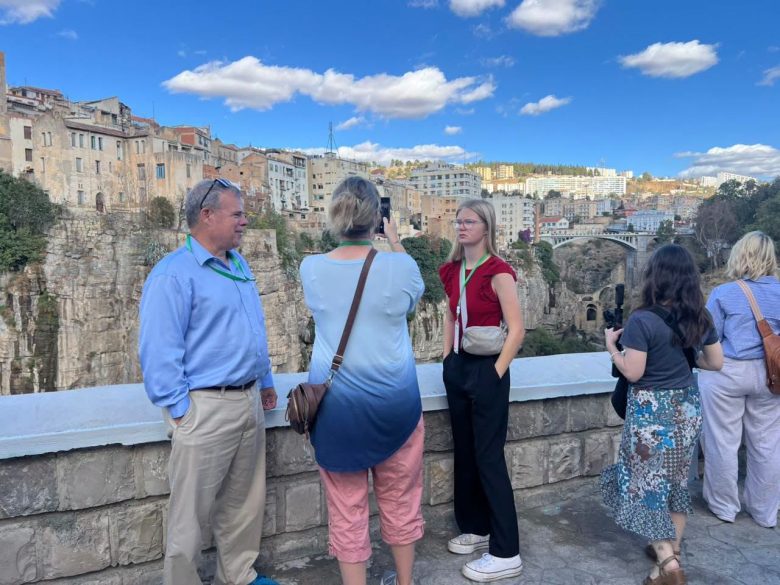
As a symbolic continuation of the bridge of camaraderie forged between both nations during the 2026 FIFA World Cup, the spans of Constantine offered the visiting American contingent from the State of Kansas far more than an architectural tour on Friday. While exploring the historic landmarks of the Old Rock city, the guests also uncovered a chapter of Algeria’s past and cultural identity, during an itinerary that had previously taken them to Tipaza and Algiers.
Led by the mayors of Lawrence—the city where the national squad established its base camp during the tournament—and Elkader, alongside former United States Ambassador to Algeria Elizabeth Moore Aubin, the group was welcomed at Mohamed Boudiaf International Airport by the Governor of Constantine, Kamel Eddine Kerbouche.
On the agenda for the Constantine stopover, the visitors explored several iconic landmarks attesting to the city’s historical and structural wealth. The Sidi M’Cid Bridge, the War Memorial, the Palace of Hadj Ahmed Bey, and the Mellah Slimane Bridge formed the primary stages of this itinerary, enabling the guests of the City of Bridges to appreciate the uniqueness of a metropolis whose terrain and Rhumel gorges have shaped its urban layout and scenery across centuries.
The Sidi M’Cid Bridge particularly captured the guests’ attention. The suspension structure, inaugurated in 1912, towers over the Rhumel at more than 175 meters. This span remains one of Constantine’s most distinctive engineering feats. Its steel framework, cables, and positioning above the chasm offer a panorama allowing one to grasp the full geographical uniqueness of the Old Rock.
The structure left the entire contingent in awe. Robert Richard Bassoff, a former professor of strategic communication at the University of Kansas, stood impressed before the monument whose depth and architectural design reminded him of the Grand Canyon in the United States. A comparison reflecting the impact left by the local landscape on the travelers, confronted with natural canyons whose scale gives the city its remarkably distinct character.
Monuments Chronicling Several Historical Eras
In remarks made on the sidelines of the tour, he also drew a parallel between the role of Constantine’s bridges and the significance of this gathering between Algerians and Americans. He stated on this matter: “The bridges of Constantine truly embody the concept of bringing people closer and linking them,” adding that “this trip, mirroring the welcome extended to the Algerian team and its fans in Kansas during the World Cup, helped strengthen friendly ties between both sides.”
For her part, Kansas City Police Inspector Meghan Bardwell, who appeared in several videos sharing the joy with national team supporters on the streets of that American city during the tournament, remained captivated by the scenic beauty offered by Sidi M’Cid. She remarked: “Simply put, Constantine is a wonderful city.”
The exploration continued at the War Memorial, erected on the heights of the Sidi M’Cid rock. This edifice, inaugurated in 1930, constitutes another major landmark in Constantine’s historical skyline.
Another stop on this route was the Palace of Hadj Ahmed Bey, one of the foremost witnesses to Ottoman-era architecture in Algeria. Built between 1826 and 1835 at the initiative of the last Bey of Constantine, Ahmed Bey, this palace stands out for its galleries, gardens, marble columns, and zellige tilework. It serves as an illustration of the architectural and artistic refinement of that era.
For Lawrence resident Thomas Scott Sherwood, this discovery sparked an interest extending beyond the scope of the trip. Impressed by the monuments and their historical depth, he indicated that this stay had inspired him to broaden his knowledge of Algeria. Upon returning to the United States, he plans to devote time to reading and research to better understand the various historical periods and civilizations that succeeded one another across Algerian territory and helped shape its identity.
Thus, in Constantine, this encounter primarily introduced the visitors to a city whose bridges represent not merely transit structures, but also emblems of its identity. A discovery that, through the exchanges and testimonies gathered, appears to have given the bonds formed during the World Cup a fresh opportunity to endure, this time across the realms of culture, history, and mutual understanding.